
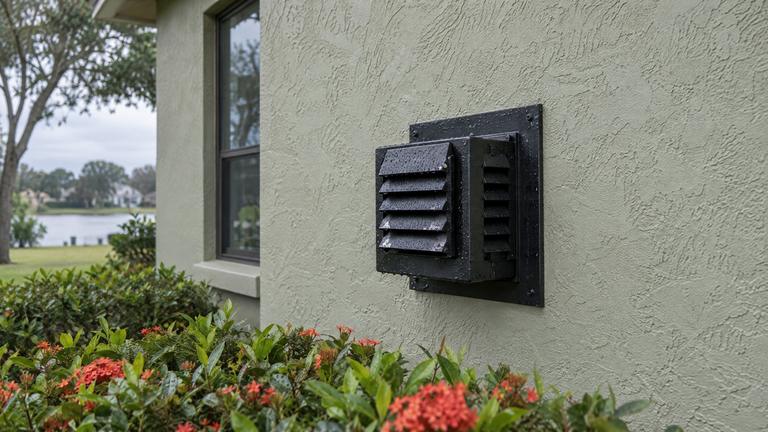
Your local gas fireplace venting team in Apopka
Our crew checks the termination, the pipe clearances and the pitch, then repairs what the manual says is wrong. No guesswork and no hidden fees.
- Licensed & insured
- Locally run
- Family owned and operated
- Same-day service available



What your gas fireplace venting estimate in Apopka covers
Spelled out in your Apopka venting estimate, which makes a side-by-side comparison with any other quote simple.
- Distance from the cap to the gas meter and regulator
- Rise or level run of horizontal pipe against the manual
- Run length compared with the maker's vent graph
- Parts of the run we could not reach, stated in writing
Getting the vent right on Apopka gas fireplaces
Vent details from the family-owned crew that works on gas fireplaces across Apopka.
Distance from windows and doors that open
How close a direct-vent cap may sit to a window or door that opens depends on the fireplace's input, which is printed on the rating plate. Under the Florida fuel gas code table, a unit rated at up to 10,000 Btu per hour needs 6 inches, one rated between that and 50,000 needs 9 inches, and anything larger needs 12 inches.
Our pros read that plate before measuring. A manual can ask for more than the code, and when the two differ we use the larger number and say so in the estimate.
Planning a deck or screen room near the vent
A deck built near a sidewall cap needs the cap at least 12 inches above its surface, and one maker allows a cap under a deck only when the space below is fully open on at least two sides. A screen room or enclosed porch can put the cap inside the new space entirely.
Our crew checks the plan against your fireplace manual before the builder starts. If the vent has to move, it is cheaper to know now than after the framing is up.
A new window or door near an existing cap
Window and door upgrades often change openings near a fireplace. The Florida fuel gas code table sets the minimum distance from a direct-vent cap to a window or door that opens, and it grows with the fireplace's input.
Our pros read the input from the rating plate, measure the planned opening and tell you whether the window or door plan works as drawn. When it does not, the estimate shows the vent change next to the window work, so you can compare the options.
Vent pipe hidden in walls and chases
Most of a gas fireplace vent runs where nobody can see it, behind drywall, stone and roofing. A visual inspection covers the cap, the connection at the fireplace and any section reachable from an attic or access panel.
When a symptom points to a hidden section, our pros explain where an opening would be needed, what the finish repair involves and what it costs, as separate lines. You decide whether to open the wall, with the facts in front of you.
Direct-vent pipe that runs up through the roof
Vertical direct-vent runs have their own limits. One maker allows vertical installations up to 40 feet with at least 8 feet of vertical rise, and up to 10 feet of horizontal run within the system using no more than two 90 degree elbows.
Each 45 degree elbow on the horizontal plane cuts that 10 feet by 18 inches in the same manual. Our pros check the rise, the horizontal sections and the elbows they can reach, then the collar and cap on the roof.
Other work in Apopka
-
-
-
-
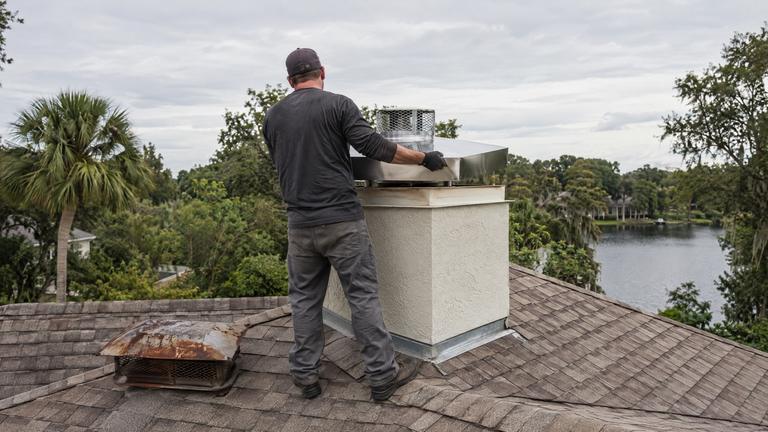


Fireplace vent questions from Apopka, answered
Not seeing your question? Our Apopka vent crew will answer it over the phone.
Can a gas insert vent through an old masonry chimney?
Many can, with a pair of flexible liners down the flue, one bringing air in and one taking exhaust out, where the manual allows it. One maker permits that only in a solid-fuel fireplace and chimney that serves no other solid-fuel appliance. We check the chimney and the manual first.
Can attic insulation touch the vent pipe?
No. One maker asks for air space all around the pipe and warns against packing it with insulation, which can cause high temperatures. Where the pipe passes into an attic, a firestop or insulation shield keeps that space open.
Request your free estimate
Share the job details and arrange a free inspection with our local team.
- Free inspection
- No hidden fees
- Family owned and operated
Need an answer now? Call (352) 675-6376
Your request is received
Thank you. We will contact you to discuss the job and confirm an appointment.