
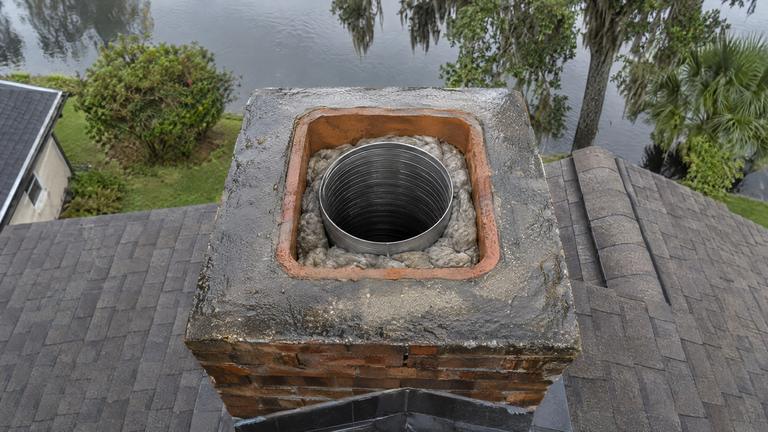
Chimney flue liner installation in Audubon Park
Clear relining proposals for Audubon Park homeowners, from a family-owned team that installs what it quotes and stands behind it.
- Licensed & insured
- Locally run
- Family owned and operated
- Same-day service available



What we measure in Audubon Park before relining
The flue tells us most of what the liner needs. Here is part of what we record in Audubon Park.
- Flue dimensions and the usable route
- Test piece or guide cone run through the flue
- Listed liner product and diameter
- Permit requirements for the job
What goes into a liner job in Audubon Park
Details that decide the liner we propose in Audubon Park, each one traceable in your estimate.
Four kinds of lining the residential code accepts
Section R1003.11.1 lists four ways to line a flue for residential appliances. Clay flue lining made to ASTM C315, chimney lining systems listed to UL 1777, factory-built chimneys or chimney units listed to go inside masonry, and other approved materials that flue gases and condensate as hot as 1,800 degrees Fahrenheit cannot corrode, erode, soften or crack.
Relining an existing chimney usually comes down to one of the first three. Your estimate names which route we propose, why it suits the chimney and the appliance, and what the other routes would involve if you want to compare them.
What goes wrong with a poorly sized liner
Liner makers warn that improper sizing may lead to excessive condensation, creosote build-up and poor draft. Those are often the very complaints relining is meant to cure, so getting the size right is the point of the job.
We explain the sizing method we used and the source it came from, whether that is the appliance manual, the code's fireplace ratios or the fuel gas rules. If you already have a liner that was sized poorly, we show you the numbers that suggest it and what a correctly sized replacement would change.
A tee and cap for cleaning at the base
On a stove connection, the liner often ends at a tee. Its removable cap lets the sweep take soot out through the base of the system instead of pushing it back into the appliance.
We place the tee where it can be reached, show you where it is before we leave and note it in the paperwork for whoever sweeps the chimney next. A tee buried behind a finished wall with no way to open it defeats its purpose, so reachability is part of the design, not an afterthought.
One run, or two joined correctly
Where a single length will not do, one manufacturer allows two lengths of flexible liner to be joined with its listed connector. Improvised joints are not part of the listing.
We plan the liner as one run where the chimney allows, and use only the connectors the instructions name when it does not. A joint also has to sit where it will not catch the liner on its way down, so its position is planned from the proven route.
Other work in Audubon Park
-
-
-
-
-


Learn more about chimney liner installation and reliningAudubon Park services
Related chimney liner work

Chimney liner questions from Audubon Park
Short answers first. The free inspection in Audubon Park fills in the details for your chimney.
Is insulation always required with a stainless liner in Audubon Park?
No. It is required in some situations, such as when clearances to combustibles cannot be confirmed, and recommended in others, such as a chimney on an outside wall. We tell you which applies to your Audubon Park chimney and price it clearly.
Can I use the fireplace right after the liner is installed?
Once the installation is finished and checked, yes, following any first-use guidance in the product instructions. We go over that guidance with you at handover.
Request your free estimate
Share the job details and arrange a free inspection with our local team.
- Free inspection
- No hidden fees
- Family owned and operated
Need an answer now? Call (352) 675-6376
Your request is received
Thank you. We will contact you to discuss the job and confirm an appointment.