
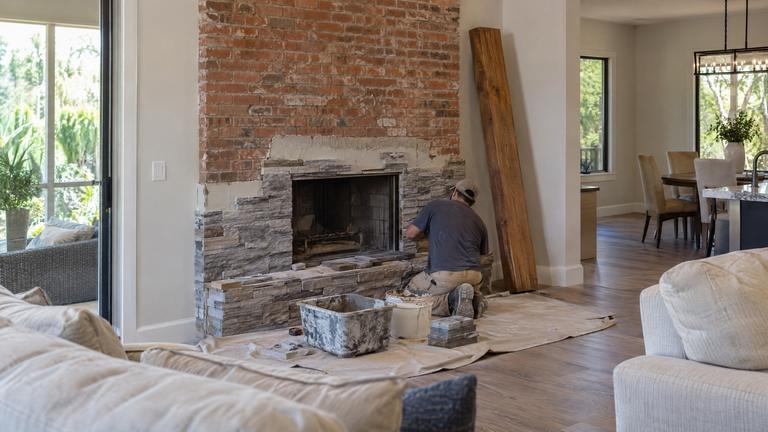
Stone veneer chimney repair by local pros in Bay Ridge
Loose stones, open joints and failing veneer repaired by our local family-owned team in Bay Ridge, beginning with a free inspection.
- Licensed & insured
- Locally run
- Family owned and operated
- Same-day service available



Stone and joint checks on your Bay Ridge chimney
Choose the lines to do now in Bay Ridge. Nothing is added later without your say.
- Roof, landscaping and walkways protected
- Joints tooled to match the existing profile
- Sealer need and product reviewed
- Flue and liner work listed separately
Getting a stone chimney repair right in Bay Ridge
What our specialists in Bay Ridge check on every stone chimney they climb.
What the code says about adhered stone veneer
Section R703.12 of the residential code covers adhered masonry veneer, the category manufactured stone falls into. It accepts the manufacturer's instructions as one installation route, and on framed walls it pairs the veneer with a water-resistive barrier plus a screed or flashing that resists corrosion at the foundation line.
In practice, that makes the maker's installation guide the working document for repairs too. We follow the guide for the stone on your chimney when one is known, and the general standard practice when the product cannot be identified.
The scratch coat under the stone
Over the lath goes a scratch coat, which one maker specifies at a minimum of half an inch up to three quarters of an inch thick, with enough pressure to fully encapsulate the lath so none is visible. The maker notes that encapsulation and thickness are key to the lath resisting corrosion.
A thin scratch coat with lath showing through is a weak point we look for when veneer fails. Rebuilt areas get a full scratch coat, scored and allowed to set as directed before stone is applied.
Full mortar coverage behind each stone
The same instructions require a setting bed with complete coverage of the back of each unit and full contact between mortar, stone and backing. Stones are back-buttered to fill their textured backs, then pressed into a half inch to three quarters of an inch of mortar until it squeezes out around the whole edge.
Stones set with a few dabs of mortar leave voids behind them. Those voids hold water and let stones pop off. When we reset veneer, every stone goes back with full coverage.
Matching the sand in the old mortar
Sand is the largest ingredient in mortar by volume, and the brief notes that the color and texture of new mortar will usually fall into place if the sand is matched successfully.
We look at the old joints closely, sometimes breaking off a sample to see the sand grains. Then we compare sands and test batches until the match is close. That extra care at the start keeps the repair from reading as a patch for years afterward.
Ledgestone and stacked courses
Ledgestone styles are laid in long, level courses, and one maker's directions say they should be installed from the bottom up, keeping each course level and plumb, with long pieces run horizontally.
A loose or missing piece breaks the line and is easy to spot. We reset pieces level with their neighbors, trim replacements to the course height and check alignment as we go, so the repair disappears into the pattern.
Other work in Bay Ridge
-
-
-
-
-


Asked in Bay Ridge about stone chimney repair
What homeowners in Bay Ridge ask while we are up on the roof, answered here.
Should my stone chimney be sealed?
Sometimes, but not by default. One manufactured stone maker says sealers are not necessary on its product and, if used, should be breathable silane or siloxane types, since a sealer can slow moisture leaving the stone. We explain whether a sealer suits your chimney.
Can I pressure wash my stone chimney?
We advise against it. One manufactured stone maker rules out power washing, sandblasting, wire brushes and acid cleaners, and high pressure can erode mortar joints on natural stone too. A mild detergent and a bristle brush are the safer start.
Request your free estimate
Share the job details and arrange a free inspection with our local team.
- Free inspection
- No hidden fees
- Family owned and operated
Need an answer now? Call (352) 675-6376
Your request is received
Thank you. We will contact you to discuss the job and confirm an appointment.