
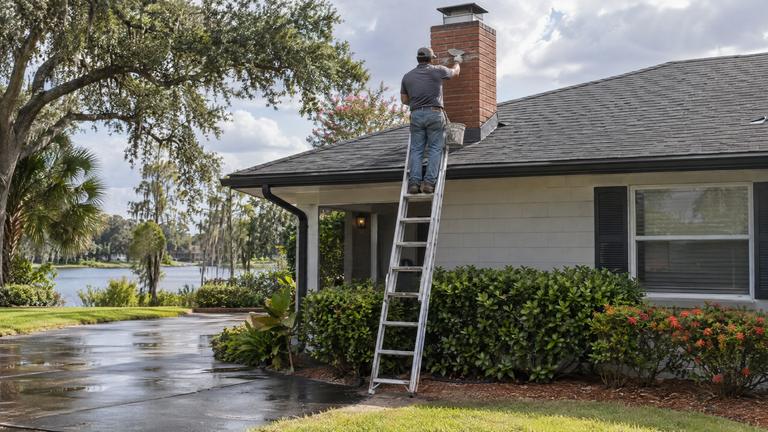
Chimney repair and diagnosis in Boggy Creek
Masonry repairs to the Florida Building Code and listed parts on metal chimneys, backed by our workmanship warranty.
- Licensed & insured
- Locally run
- Family owned and operated
- Same-day service available



Every repair named before work begins
- Rust on lintels, support angles and ties
- Cleanout door and any stovepipe entry
- Chase siding, barrier and framing condition
- Stains and white deposits, cleaned after the water fix
Chimney repair from the cap down to the firebox
Water, heat and movement wear a chimney out
Three forces wear a chimney down over time. Water gets in at the top and at the roofline, soaking mortar, rusting metal and staining the rooms below. Heat works from the inside, on the flue lining and the chamber above the damper. Movement shows up as cracks and gaps where masonry has shifted or pulled away from the house.
One visible symptom can come from more than one force. A cracked joint may be years of water working into the mortar, or masonry moving because something beneath it has shifted. BIA guidance on maintaining brick says the origin of a problem should be found and both the cause and the visible effect corrected, which is why a patch over the mark alone does not settle it.
At your Boggy Creek home, each finding is sorted by the force behind it before anything is priced. The written estimate groups the repairs the same way, so you can see which lines stop water, which deal with heat damage and which address movement.
Base flashing and counterflashing work as a pair
Where a chimney passes through the roof, two layers of metal keep water out. Base flashing goes in first. It turns up the face of the chimney and runs out along the roof, and the roofing laps over it, so water on the roof flows across the metal rather than into the joint.
Counterflashing comes second. It is set into the chimney masonry and laps down over the top edge of the base flashing, covering the gap where that layer meets the brick. BIA guidance has the counterflashing lap the base flashing by at least three inches, while the Florida Building Code requires counterflashing on a shingle roof to be corrosion-resistant metal of a set minimum thickness.
When either layer is missing, bent, loose or rusted, water can find its way behind the other. The fix belongs to our chimney flashing repair service, and the estimate says which layer failed and which one stays.
Why caulk at the roofline keeps failing
A line of roofing cement or caulk along the base of a chimney often marks a leak someone has already tried to stop. It may slow water for a while, but it does not take the place of the flashing that belongs at that joint.
The difference is in how each one handles water. Flashing works by overlapping, each piece lapping over the one below so water runs off it. A bead of caulk works only while it stays stuck to both surfaces, and it has no lap to fall back on. Once the bond breaks, water gets in behind the bead.
Where layers of old caulk cover the roofline, enough of it comes off to show what is underneath. Missing or failed flashing then goes on the estimate as flashing work, and chimneys in Boggy Creek do not simply get another bead on top of the old ones.
Same-day visits when the schedule allows
Same-day service is available when the schedule allows. A sudden leak around the chimney, a damper stuck open or a piece of masonry that has come loose are the problems where an early look helps most, because each one can get worse while it waits.
The first visit is for finding the cause and writing the estimate. No repair work goes ahead until you have approved that estimate, even when the fix turns out to be small, and homeowners in Boggy Creek see what the repair involves before anything starts.
When you get in touch, a clear description helps us plan the visit. These details cover most of it.
- What you see, where it is and when it started
- Whether it shows up only when it rains
- Whether the fireplace has been used since
- Roof access, gates and pets
Other work in Boggy Creek
-
-
-
-
-


Quick answers on chimney repair
What if the crew finds more damage once work begins?
Nothing beyond the approved estimate is done without you. What was found and what it changes are explained, the added work is priced in writing and it goes ahead only with your approval. The original estimate stays the reference for everything else.
Do I need to go up on the roof to show you the problem?
No, please stay off the roof. Tell us what you noticed from inside and from the ground, such as a stain, fallen debris or a leaning cap. Our crew handles the access and the close look during the free inspection.
Request your free estimate
Share the job details and arrange a free inspection with our local team.
- Free inspection
- No hidden fees
- Family owned and operated
Need an answer now? Call (352) 675-6376
Your request is received
Thank you. We will contact you to discuss the job and confirm an appointment.