

Your chimney chase repair crew in Christmas
Chimney chase repair for Christmas homes, with a free inspection, a line-by-line written estimate and a 100% satisfaction guarantee.
- Licensed & insured
- Locally run
- Family owned and operated
- Same-day service available



Chase work written up for Christmas homeowners
- Tap test for hollow or loose stucco
- Siding removed and reused where boards are sound
- Stucco rebuilt in three coats over new lath
- Temporary cover over any open section each day
What a lasting chase repair takes
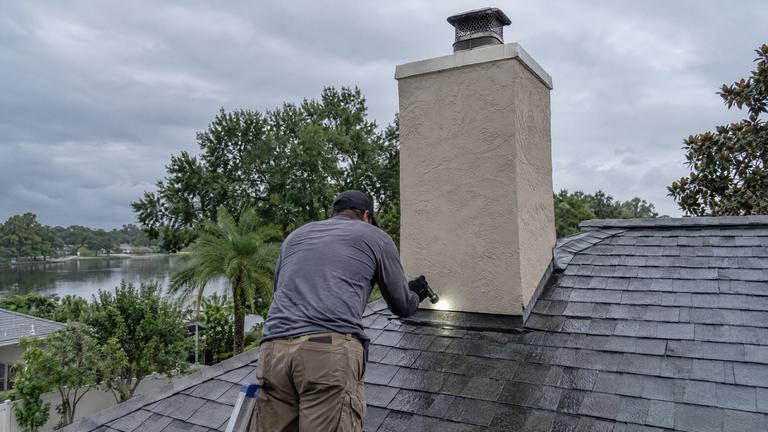
Step flashing along the sides of a roof chase
Where a chase wall runs down the slope of a shingle roof, the joint needs flashing that works with each course of shingles. Florida's residential code, in R905.2.8.3, requires sidewall flashing by the step-flashing method or with continuous L flashing.
Step flashing uses one bent piece per shingle course, each lapped over the one below, so water is handed down the roof. The upright leg runs up the chase wall behind the barrier and siding. When siding is nailed through that leg, or the flashing sits on top of the siding, water gets behind it.
When our crew opens a chase base in Christmas, the side flashing is checked piece by piece. Bent or corroded pieces are replaced, and the siding goes back with the right lap. If the roof itself needs work, we coordinate with your roofer.
Wall chases that reach down to the ground
A chase that runs from the ground up the side of the house has a bottom edge that stays wetter than the rest. Soil, mulch, sprinkler spray and rain splashing off a walkway all reach the lowest boards and the sill.
The Florida Building Code, section R317.1, calls for wood that sits close to the ground or to exposed slabs, including siding, sheathing and wall framing, to be naturally durable or preservative-treated. That is why the sill of a wall chase gets the closest look.
When we repair the bottom of a wall chase, rotted sill and stud ends are replaced with decay-resistant material where the code calls for it. We check the clearance to soil and mulch and point out sprinklers aimed at the wall. Small changes like those keep the new wood dry.
Giving water that gets past the siding a way out
Siding and stucco both let a little water through. Section R703.1.1 of the Florida Building Code describes an exterior wall that keeps water from building up inside it, using a water-resistive barrier plus a way to drain water that gets past the cladding back to the outside.
On a chase, that drainage path ends at the bottom edge of the siding or at the flashing on the roof. If the bottom edge is caulked shut or buried in roofing cement, water that should drain out stays in the wall.
We check that the base of each chase wall can drain. Sealant that blocks the path comes out, and the bottom edge is detailed so water leaves the wall at the flashing. That detail is written into the estimate, so it does not get lost between trades.
Matching stucco texture on a partial repair
A patch that is sound but does not match the wall still bothers most people. Stucco texture depends on the finish coat, the tool and the hand of the person applying it, and old stucco has been weathered by years of sun and rain.
Our crew can make a small test area to match the texture before the finish coat goes on the repair. Color is usually handled with paint over the whole face, since new stucco seldom matches weathered color on its own. Sand size and how the finish coat is floated or thrown both change the look, so the test area may try more than one approach.
We tell you before the job whether a patch will blend in or show, and the estimate says whether painting the full face is included. If the chase and house were painted together, we note the paint color so the touch-up matches.
Other work in Christmas
-
-
-
-
-
-


What homeowners ask about chase work
Do I need a new cover on top when the chase is repaired?
Only if the cover has failed or no longer fits the repaired top. When it has, the cover goes on its own estimate line and is installed after the top framing is sound. If the cover is in good shape, we take it off carefully and put it back.
What happens to the chimney pipe while you work on the chase?
The pipe stays in place and is protected while the framing around it is replaced. Our crew keeps the listed air space clear and puts firestops, shields and supports back where the chimney maker's instructions call for them.
Request your free estimate
Share the job details and arrange a free inspection with our local team.
- Free inspection
- No hidden fees
- Family owned and operated
Need an answer now? Call (352) 675-6376
Your request is received
Thank you. We will contact you to discuss the job and confirm an appointment.