
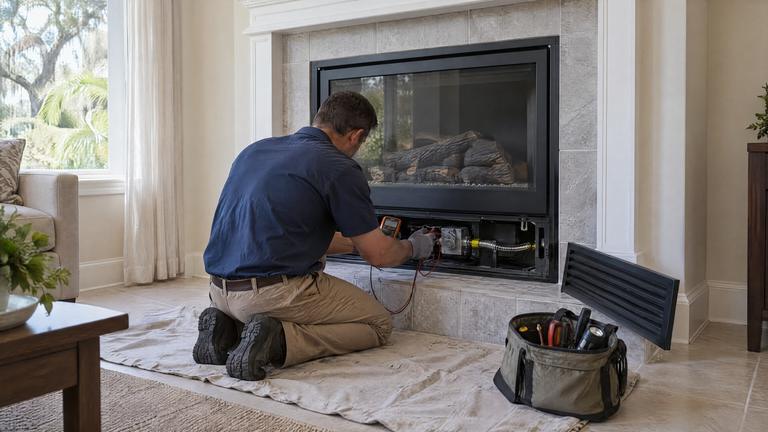
Ventless fireplace service from local pros in Countryside
Same-day ventless fireplace visits in Countryside when the schedule allows, with a free inspection and upfront pricing.
- Licensed & insured
- Locally run
- Family owned and operated
- Same-day service available



Your ventless fireplace inspection in Countryside, point by point
Nothing here is guessed over the phone. Each point is seen in person at your Countryside home.
- Pilot air inlet and orifice checked for lint
- Ignitor, electrode, cable and battery tested
- Embers and decorative media reviewed against the manual
- Screen, hood and glass door arrangement checked
Where a ventless fireplace repair starts in Countryside
The engineering behind a clean, steady vent-free flame, as our Countryside specialists apply it.
Matching the log set to the firebox size
Each vent-free log set ships with minimum firebox dimensions. One maker lists its 18 inch set as needing a firebox at least 24 inches high, 14 inches deep, 28 inches wide at the front and 20 inches at the rear, with wider front and rear figures for its 24 inch set.
A firebox manual also warns against installing a heater in a box that misses the heater's minimum size. Our specialists measure yours against the chart for the set you own and record the numbers in your service file.
Fans and drafts that push the flame into the logs
Every vent-free manual we work from carries the same warning. Do not let fans blow directly into the fireplace, and avoid any draft that alters the flame pattern. A pushed flame touches the logs, and flame on the logs makes soot.
A firebox maker adds kitchen exhaust fans, return air registers, windows and doors to the list of draft sources. Our technicians watch the flame with the room set up the way you live in it, air conditioning and fans included.
Orifice alignment in the burner venturi
On some vent-free burners, primary air enters through a venturi tube at the back. One manufacturer notes that airflow drops when lint or dirt builds up around the venturi, or when the gas orifice sits off center or out of line with the venturi inlet.
The maker describes a correction for a misaligned orifice. That adjustment belongs in trained hands, and our specialists make it only where your manual describes it, then confirm the flame afterward.
Regulator, sediment trap and shutoff valve
The supply side of a vent-free fireplace has its own parts. One manual calls for an external regulator between the gas supply and the heater, recommends a sediment trap to catch moisture and contaminants, and requires an accessible equipment shutoff valve with a test gauge connection.
Our technicians confirm those parts are present when we service the appliance. Piping changes upstream of the appliance connection are gas supply work, and we name them for your gas supplier or gas contractor on a separate line.
A former wood fireplace made ready for vent-free logs
Before vent-free logs go into a fireplace that once burned wood, the manuals ask for a clean start. The flue and firebox must be cleaned of soot, ashes and loose paint, and one maker explains that creosote left behind can soften when heated and drop onto the logs, causing odors and soot.
When a set went in without that cleaning, the symptoms show up as smells and dark logs. Our specialists find the residue, explain the cleaning it needs and enter it on the estimate as its own line.
Other work in Countryside
-
-
-
-
-
-


Learn more about ventless gas fireplace serviceCountryside services
Common vent-free questions in Countryside
No sales pitch here, only answers from our Countryside specialists, and a free inspection when you want one.
How big does the room need to be for a ventless fireplace?
Section 621.5 of the Florida fuel gas code limits unvented heaters to 20 Btu per hour per cubic foot of the space. Manuals also use 50 cubic feet per 1,000 Btu per hour of all appliances in the space to decide whether it is confined. We run both calculations during the free inspection.
Should the damper be closed with vent-free logs?
One vent-free log set manual says the set can operate with the flue damper closed, while warning never to seal the damper itself. If the set is run as a vented appliance instead, the damper has to be clamped open and the thermostat function is not allowed.
Request your free estimate
Share the job details and arrange a free inspection with our local team.
- Free inspection
- No hidden fees
- Family owned and operated
Need an answer now? Call (352) 675-6376
Your request is received
Thank you. We will contact you to discuss the job and confirm an appointment.