
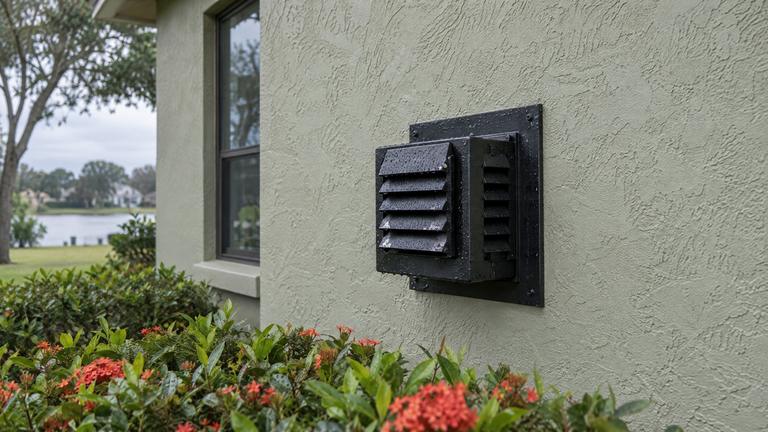
Gas fireplace venting from a family-owned team in Dr. Phillips
A vent run built from the manual and tested with the fireplace burning before we pack up. Family owned, locally owned and working in Dr. Phillips.
- Licensed & insured
- Locally run
- Family owned and operated
- Same-day service available



Checked on every vent visit in Dr. Phillips
Each point below is measured or checked at your Dr. Phillips home and matched to the fireplace manual before it reaches your estimate.
- Air space between the pipe, framing and insulation
- Firestops and wall passes at each penetration
- Elbow count and total turns in the run
- Your 10% discount for booking within 72 hours, listed on the estimate
Gas fireplace venting details that matter in Dr. Phillips
Our Dr. Phillips crew talks every homeowner through points like these at the free inspection.
The restrictor at the flue outlet
Some direct-vent installations call for a restrictor where the vent leaves the fireplace. In one maker's manual, a top-vent unit whose first piece is a 90 degree elbow toward a sidewall needs an open-center restrictor made by breaking the center rib out of the supplied part.
A restrictor that is missing, or of the wrong style for the layout, changes how the fire draws. Our technicians check which restrictor your manual calls for, whether it is in place and whether it matches the route the pipe actually takes.
Air space around the vent pipe
Vent pipe needs open air around it. In one maker's chart, horizontal pipe keeps 3 inches of space above it and 1 inch below and to each side until it reaches the outside wall, and the pipe keeps a 1 inch gap on every side where it passes through that wall and wherever it runs vertically.
The same maker warns that stuffing insulation or anything else into those gaps can drive temperatures up and create a fire hazard. Our crew checks every section it can reach for framing, wiring or insulation crowding the pipe and lists any correction in the estimate.
- 3 inches above horizontal runs in that manual
- 1 inch at the sides and bottom
- 1 inch all around at walls and on vertical runs
Keeping the cap clear of the gas meter
One maker's termination chart keeps a direct-vent cap 3 feet to each side of the centerline of a gas meter and regulator assembly, for a height of 15 feet above it, and 3 feet from a service regulator vent outlet.
Meters get moved when services are upgraded, and caps get added when fireplaces are installed after the house was built. Our pros measure the relationship between the two on every sidewall vent they inspect, and they note which rule applies.
Room to breathe in front of the cap
A sealed fireplace pulls its combustion air in at the cap, so the space in front of the cap matters. One direct-vent manual keeps a 24 inch zone in front of the termination hood free of shrubs, garden sheds, fences, decks and utility buildings.
Yards change. A hedge fills in, a shed gets delivered, a gate goes in. Our crew measures that 24 inch zone on every sidewall vent and tells you exactly what has to move.
- Bushes and hedges
- Garden sheds and utility buildings
- Fences and gates
- Decks built after the fireplace
Type B pipe, listed for gas
B-vent is double-wall pipe made for gas appliances with draft hoods. Section 503.6.1 of Florida's fuel gas code calls for Type B and BW pipe listed under UL 441, and one fireplace manual insists on Type B pipe carrying a listing from a nationally recognized testing agency.
The same manual sizes the vent by model, 4 inch pipe for one and 6 inch for others. Pipe that is too large or too small shows up in that manual's poor-draft troubleshooting, so our pros check the size as well as the type.
Other work in Dr. Phillips
-
-
-
-
-
-


Before your vent repair in Dr. Phillips
Not seeing your question? Our Dr. Phillips vent crew will answer it over the phone.
Why does my gas fireplace go out after a few minutes?
On a direct-vent unit, one maker lists a leak in the inner exhaust pipe, a horizontal run with the wrong pitch and a blocked or badly fitted cap as causes. Pilot and control faults can do the same thing, so our technicians test both before quoting.
Can I use the fireplace while I wait for a vent repair?
We recommend keeping it off while a vent fault is unresolved. A sealed fireplace depends on its vent to bring air in and take exhaust out, so running it with a known fault is not worth the risk.
Request your free estimate
Share the job details and arrange a free inspection with our local team.
- Free inspection
- No hidden fees
- Family owned and operated
Need an answer now? Call (352) 675-6376
Your request is received
Thank you. We will contact you to discuss the job and confirm an appointment.