
Your gas fireplace repair team in Falcon Trace
Save 10% on gas fireplace repair booked within 72 hours after the inspection and get upfront pricing on every line.
- Licensed & insured
- Locally run
- Family owned and operated
- Same-day service available



Repair lines and service lines, kept apart
- Thermocouple and thermopile readings at the valve
- Burner ports, burner alignment and orifice condition
- Shutoff valve located and its access confirmed
- Glass, venting and vent-free items routed to their service
What goes into a gas fireplace repair that holds
Following the start sequence step by step
No flame is the complaint, but it is the end of a chain, not a diagnosis. A gas fireplace starts in a fixed order, and manufacturer troubleshooting charts walk through it one step at a time.
Where the chain stops points to the part. A spark with no pilot sends the check toward gas supply, a blocked pilot orifice or the spark position. Sparking that carries on after the pilot lights points toward flame sensing, and a steady pilot with a dark burner points toward the switch circuit, the module output or the valve.
In your Falcon Trace home, the step where the start stopped is noted and written on the estimate beside the part it implicates. Each start is followed through these stages.
- The call for heat from a switch, remote or thermostat
- A spark or ignitor at the pilot
- A pilot flame that lights and is sensed
- Gas released to the main burner
The burner orifice and its size
The main burner orifice, which some manuals call the injector, is a fitting with a precisely sized hole. That size sets how much gas the burner receives. The rating plate lists it, and the maker's service parts list names the right one for each model and gas.
Two things can go wrong. Soot, dirt, lint or corrosion can partly block it, and a wrong orifice can end up in the unit after earlier work or a conversion. A yearly checklist from one manufacturer covers both, asking the technician to inspect the orifice for soot, dirt and corrosion and to confirm its size against the parts list, and other manuals add clearing lint from around the injector.
During a repair in Falcon Trace, the orifice is checked against the plate and the parts list. A dirty one is cleaned as the manual allows, and a wrong or damaged one is replaced with the listed part and shown on the estimate as its own line.
A broken log means the fireplace stays off
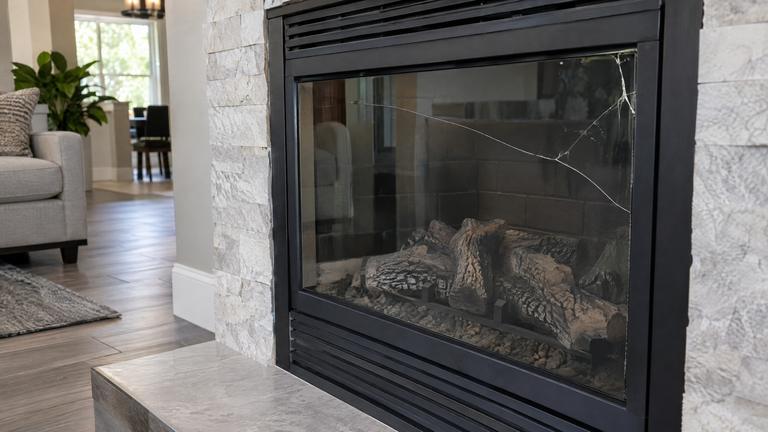
Two vent manuals from one maker put it bluntly. Do not operate the fireplace if any log is broken. A broken log no longer sits the way the diagram shows, and until it is replaced the fireplace stays off.
Logs are fragile, as one set of installation instructions warns, and they can crack when they are handled. A yearly checklist we work from has the technician inspect for damaged or missing logs, replace them as necessary and then confirm the set is placed so that no flame strikes a log and leaves soot.
Replacement logs come from the maker's parts list for your model, identified by part number. The estimate lists each log that needs replacing by that number, so the set goes back complete and in the positions the diagram shows.
Ticking and pinging as the fireplace heats
Steel moves as it heats and cools. A question table in one owner's manual describes a metallic noise caused by metal expanding and contracting, like a furnace or heating duct, and says it does not affect the operation or longevity of the appliance. Two vent manuals from another maker call the same start-up and cool-down sounds normal for fireplaces made of steel.
Timing separates normal from not. Expansion noise shows up as the unit warms and again as it cools, then settles. A steady grind, rattle or hum that lasts as long as the fan runs comes from a moving part, and a sound that began after a repair or after the logs were moved deserves a mention.
On service visits in Falcon Trace, our technician listens through a lighting cycle before deciding that a noise needs a part. If it is only expansion, you hear that plainly and nothing is added to the estimate.
Other work in Falcon Trace
-
-
-
-
-


Learn more about gas fireplace repair and serviceFalcon Trace services

What homeowners ask about gas fireplace repair
Is it safe to keep using the fireplace until the repair?
It depends on the fault. Makers say not to run a gas fireplace with cracked or missing glass, a broken log or any part that has been under water. One maker's lighting instructions also say to stop and call a technician after three failed tries. Our technician tells you which case applies to yours.
Do you work on the gas line to the fireplace?
No. Work on the gas supply piping is done by a qualified gas installer or plumber. On the appliance side, our technicians read the gas pressure and check the accessible connections for leaks, and the estimate says plainly if the piping needs a plumber.
Request your free estimate
Share the job details and arrange a free inspection with our local team.
- Free inspection
- No hidden fees
- Family owned and operated
Need an answer now? Call (352) 675-6376
Your request is received
Thank you. We will contact you to discuss the job and confirm an appointment.