
Stone chimney repair in Goldenrod
Loose stones, open joints and failing veneer repaired by our local family-owned team in Goldenrod, beginning with a free inspection.
- Licensed & insured
- Locally run
- Family owned and operated
- Same-day service available



Stone findings that shape your Goldenrod quote
Choose the lines to do now in Goldenrod. Nothing is added later without your say.
- Natural stone or manufactured veneer identified
- Solid stone or facing over a backing noted
- Mortar color, sand and joint profile matched
- Drainage at the base and terminations checked
Before your stone chimney is repaired in Goldenrod
Code sections, the maker's directions and mortar basics for stone chimneys in Goldenrod.
Telling solid stone from veneer
A few clues help. Thin stones with flat backs, a metal screed along the bottom edge and a hollow sound when tapped point to veneer. A chimney built as a framed chase points to veneer over framing. Thick, irregular stones that turn corners as whole units suggest solid masonry.
Clues are not proof, so we check from several angles, including the attic or the firebox side where the chimney can be seen. When the answer matters for the repair and cannot be seen, we explain what a small opening would show.
The layers behind manufactured stone
On a wood-framed chase, one maker's instructions list the assembly in order, sheathing, two layers of water-resistive barrier, galvanized metal lath, a scratch coat, a mortar setting bed, the stone and the mortar joint. Each layer has a job, and a failure in one shows up in the stone.
When a section of veneer comes loose, we look at every layer behind it before resetting anything. Rebuilding the missing layer along with the stone is what makes the repair last.
- Sheathing on the framing
- Two layers of water-resistive barrier
- Metal lath and scratch coat
- Setting bed, stone and joint
Filling deep joints a layer at a time
Where the old mortar came out more than about an inch deep, the brief has the deep spots filled first, packing mortar in layers of roughly a quarter inch and letting each reach thumbprint hardness before the next goes on. Most shrinkage happens as mortar hardens, so layering keeps it small.
Deep stone joints take several layers and more time. We price that time honestly, because a deep joint filled in one go shrinks, cracks away from the stone and lets water straight back in.
Why repointing mortar is softer than the stone
Preservation Brief 2 sets out that new mortar must have greater vapor permeability and be softer, measured in compressive strength, than the masonry units, and be as permeable and as soft or softer than the historic mortar.
The reasoning is practical. Joints are meant to be the part that wears and gets repointed. A mortar harder and tighter than the stone forces moisture and stress into the stone faces instead, and the stone pays for it. We choose the mix with that rule in mind.
River rock and rounded stone chimneys
Rounded river rock has little flat surface to rest on, so the mortar does much of the holding. As joints erode, rocks lose their grip and can drop out.
Repairs on rock chimneys mean deep, careful repointing that packs mortar well around each rock and resetting loose ones in fresh mortar. Joint profiles on rock chimneys vary, from recessed to full, and we match the style of your chimney.
Other work in Goldenrod
-
-
-
-
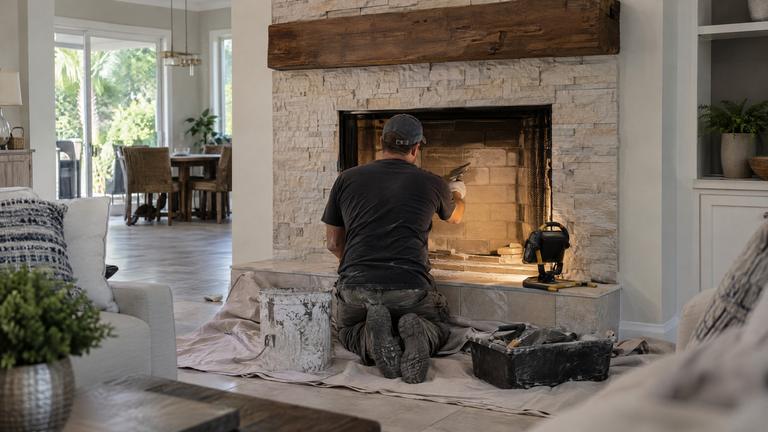
-
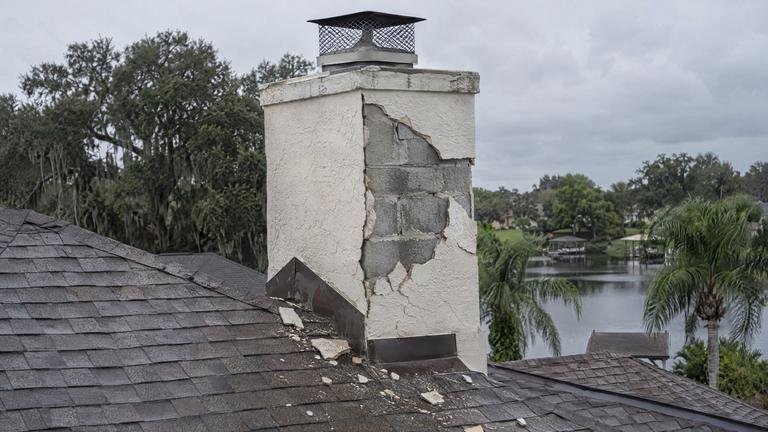


Asked in Goldenrod about stone chimney repair
What homeowners in Goldenrod ask while we are up on the roof, answered here.
Can you repair cultured stone on my chimney?
Yes. Manufactured stone is repaired to its maker's directions, which cover the backing, the setting bed, joint width and cleaning. We remove loose units, check what is behind them and reset or replace them with full mortar coverage.
How often should a stone chimney be inspected?
Under NFPA 211, a chimney, its fireplace and its vents are inspected every year at a minimum. For a stone chimney, that yearly visit is a good time to tap the stones, check the joints and look at the cap and flashing.
Request your free estimate
Share the job details and arrange a free inspection with our local team.
- Free inspection
- No hidden fees
- Family owned and operated
Need an answer now? Call (352) 675-6376
Your request is received
Thank you. We will contact you to discuss the job and confirm an appointment.