
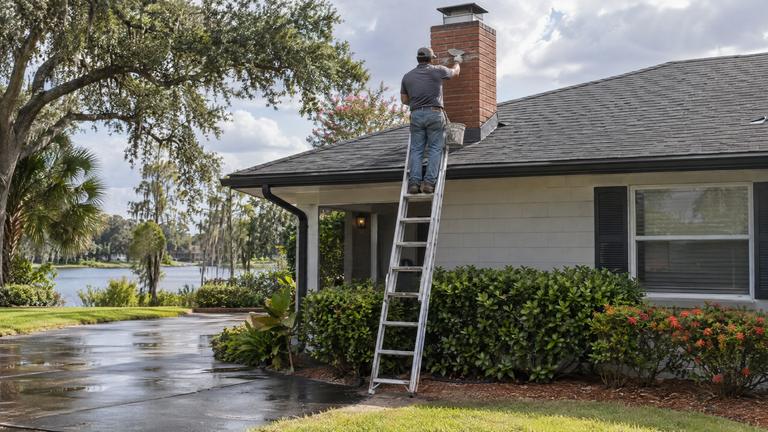
Masonry and factory-built chimney repair in Lake Como
Every chimney repair we finish carries our 100% satisfaction guarantee and our workmanship warranty.
- Licensed & insured
- Locally run
- Family owned and operated
- Same-day service available



The chimney parts we price for Lake Como homes
- Mortar joints to repoint, marked by area
- Cleanout door and any stovepipe entry
- Weep holes and through-flashing at a veneer base
- Chase top, collar and cap on metal chimneys
Repairs that fit the way your chimney is built
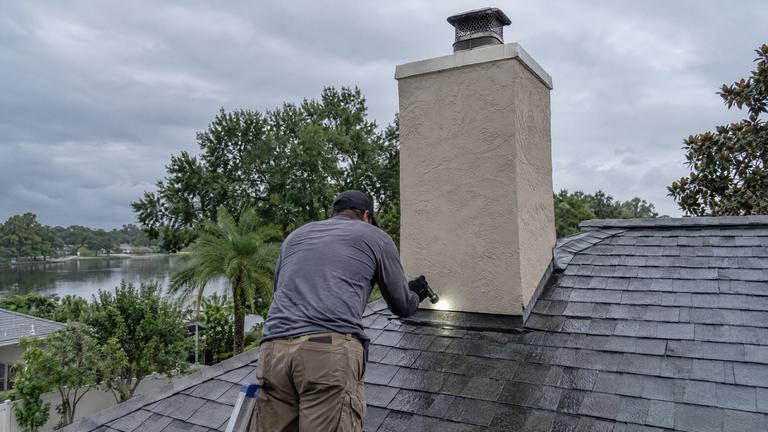
Base flashing and counterflashing work as a pair
Where a chimney passes through the roof, two layers of metal keep water out. Base flashing goes in first. It turns up the face of the chimney and runs out along the roof, and the roofing laps over it, so water on the roof flows across the metal rather than into the joint.
Counterflashing comes second. It is set into the chimney masonry and laps down over the top edge of the base flashing, covering the gap where that layer meets the brick. BIA guidance has the counterflashing lap the base flashing by at least three inches, while the Florida Building Code requires counterflashing on a shingle roof to be corrosion-resistant metal of a set minimum thickness.
When either layer is missing, bent, loose or rusted, water can find its way behind the other. The fix belongs to our chimney flashing repair service, and the estimate says which layer failed and which one stays.
Step flashing on a shingle roof
On an asphalt shingle roof, the sides of a chimney are flashed with the roofing. The Florida Building Code allows flashing against a vertical sidewall by the step-flashing method or with continuous L flashing, and it sends chimney flashing on a shingle roof to the shingle manufacturer's instructions.
Step flashing is a run of short bent pieces, each tucked in with a course of shingles and turned up the chimney, so every piece sheds water onto the shingle below it. Continuous L flashing is one long angle along the side instead. Where the code spells out an L flashing method, it starts the flashing at the lower part of the roof so every metal lap sheds water.
The shingle maker's instructions control the details, and our crew follows the ones for the shingle on your roof. Your estimate spells out the method, the metal and how the counterflashing will lap over it.
The label on a relined flue
When a flue is relined with a material outside the standard list in the Florida Building Code, the code asks for a permanent label in plain view close to where the connector enters the chimney. It names the type of appliance and the fuel the flue is for, and warns against connecting anything else.
The label matters more later than on the day of the install. It tells the next buyer, home inspector or installer what the flue was built for. Without it, someone may connect a different appliance to a liner that was never meant for it, or assume a lining suits a new appliance when it does not.
If your chimney was relined and the label is missing or unreadable, it is worth putting back. Our technicians identify the lining where it can be seen and confirm what it serves. A replacement label goes on the estimate alongside any other flue repair, and if the lining cannot be identified, the estimate says so.
The cleanout door at the base of a flue
A small metal door at the bottom of a chimney, outside or in a utility space, is usually a cleanout. The Florida Building Code requires a cleanout opening close to the base of each masonry chimney flue, with a noncombustible cover, so ash and debris can be taken out. Fireplace flues that can be cleaned through the fireplace opening are the exception.
Cleanout doors rust, warp and lose their latches. One that is missing or hangs open gives animals and water an easy way in, and one rusted shut leaves debris sitting at the base out of sight.
Replacing the door is a small job, but the frame has to sit tight in the masonry so the new cover closes properly. The base of the flue is cleared first, then a noncombustible door and frame are fitted. Any of these signs puts the door on the estimate.
- A door that will not latch or close flush
- Rust holes or a warped frame
- Loose mortar around the frame
- Ash or debris spilling from the opening
Other work in Lake Como
-
-
-
-
-
-


Chimney repair answers for Lake Como homes
What parts of the chimney does your repair service cover?
All of it, from the cap and crown down through the flashing, brick, mortar, flue lining, smoke chamber and damper, plus framed chases and factory-built chimneys. Each damaged part gets its own line on the written estimate. When a part has its own specialist service with us, such as liner installation, the estimate says so.
Do you repair factory-built metal chimneys as well as brick ones?
Yes. A factory-built chimney is a listed system, so repairs use the maker's listed parts and follow its installation instructions, as the Florida Building Code requires. Masonry chimneys are repaired to the code's masonry rules, and the estimate says which approach applies.
Request your free estimate
Share the job details and arrange a free inspection with our local team.
- Free inspection
- No hidden fees
- Family owned and operated
Need an answer now? Call (352) 675-6376
Your request is received
Thank you. We will contact you to discuss the job and confirm an appointment.