
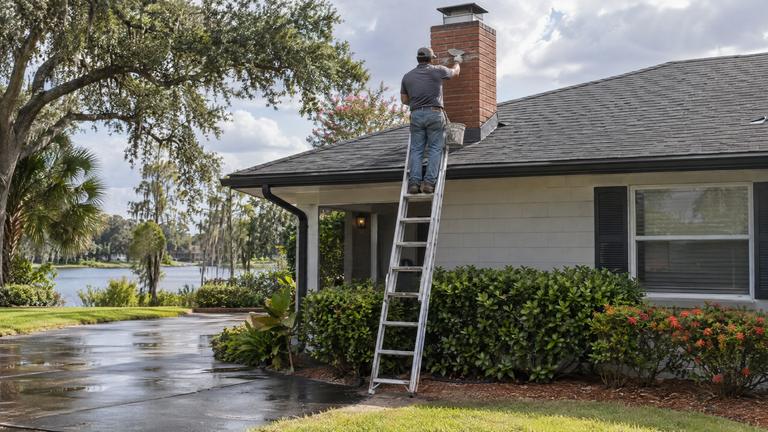
Chimney repair from the cap to the firebox in Lake Formosa
Your Lake Formosa chimney, checked from the cap to the firebox and repaired where it failed.
- Licensed & insured
- Locally run
- Family owned and operated
- Same-day service available



Every repair named before work begins
- Spalled or broken brick to replace
- Cracks mapped by location and pattern
- Air space and fireblocking at attic and floors
- Stucco or stone finish and the backing behind it
How we repair chimneys in Lake Formosa
Where the flue liner meets the crown
A flue liner should stand up out of the crown rather than stop flush with it. BIA guidance shows the liner extending above the top of the cap, and the Florida Building Code requires a caulked bond break around any flue liner at the cap.
The point of a bond break is that the liner and the cap stay separate pieces. BIA guidance has the cap and liner interface thoroughly primed, backed and sealed to reduce the potential for water getting in. Solid mortar packed tight against the liner locks the two into one rigid piece, and a rigid joint that cracks opens a path for water right beside the flue.
This joint gets its own look on every chimney. The fix is written as a separate item, apart from any work on the crown surface.
- Cracked mortar packed against the liner
- A missing or split sealant bead
- A liner that stops at or below the crown surface
White deposits on the brick
A white, powdery film on chimney brick is likely efflorescence. BIA guidance explains that it needs three conditions at the same time, and it forms when water carrying dissolved salts reaches the surface and evaporates, leaving the salts behind.
Those salts show on the brick but usually come from what touches it, such as mortar, concrete or soil. That makes efflorescence a water sign more than a brick defect, and BIA notes it is usually not harmful to the brick itself.
Cleaning comes last. BIA guidance says to identify and correct the source of water and let the brickwork dry before cleaning recurring efflorescence, and light deposits can be removed by dry brushing or with a stiff fiber brush and water. On the estimate, the water repair comes first and any cleaning follows it.
- Soluble salts in or touching the brickwork
- Water in contact with them long enough to dissolve them
- A path through the masonry to a surface where water can evaporate
The metal top of a framed chase
The top of a chase is sheet metal, and on a factory-built chimney it is part of the system. One maker's instructions, DuraVent's for its DuraChimney II chimney, set the chase top flashing on spacers above the framing, leave a ventilation opening around the pipe, seal a collar to the pipe just above the flashing and place the chimney cap above that.
A flat or sagging top holds water, and rust starts where water sits, then runs down the siding as streaks. A top sealed tight to the pipe or pushed down onto the framing can also close off the ventilation space those instructions call for.
Replacing it means matching the chimney system underneath, not only the size of the box. Our chase cover replacement service checks the points below before a new top is specified, and the estimate lists the top, the collar and any framing repair as separate items.
- The chase size and the pipe diameter
- The collar and its seal to the pipe
- Rot or rust in the framing under the old top
- Clear ventilation space around the pipe
Fireblocking where the chimney passes floors
The air space around a masonry chimney stops at each floor and ceiling it passes through. There the Florida Building Code requires fireblocking of noncombustible material, securely fastened, so flame and hot gases cannot travel up the gap. Between wood joists and the chimney it must be self-supporting or rest on strips of metal or metal lath.
The same code asks for fireblocking in concealed spaces of wood-framed walls at ceiling and floor levels, and around openings for vents, pipes and ducts. A framed wall or chase built around a chimney is that kind of concealed space.
Fireblocking can be missing, loose or made of wood or foam that does not belong at a chimney, and it tends to come to light only when a ceiling or wall is opened for some other reason. When a chimney wall or ceiling in your Lake Formosa home is opened for a repair, the fireblocking is checked, and restoring it in noncombustible material is priced on the estimate.
Other work in Lake Formosa
-
-
-
-
-


Chimney repair questions from Lake Formosa homeowners
Can we keep using the fireplace until the repair is done?
It depends on what is damaged. A cracked flue lining, a damaged smoke chamber or a damaged firebox means no fires until the repair is finished. Outside damage lower down, such as a worn joint, may not affect use, and the estimate states which case applies to your chimney.
Do you repair factory-built metal chimneys as well as brick ones?
Yes. A factory-built chimney is a listed system, so repairs use the maker's listed parts and follow its installation instructions, as the Florida Building Code requires. Masonry chimneys are repaired to the code's masonry rules, and the estimate says which approach applies.
Request your free estimate
Share the job details and arrange a free inspection with our local team.
- Free inspection
- No hidden fees
- Family owned and operated
Need an answer now? Call (352) 675-6376
Your request is received
Thank you. We will contact you to discuss the job and confirm an appointment.