
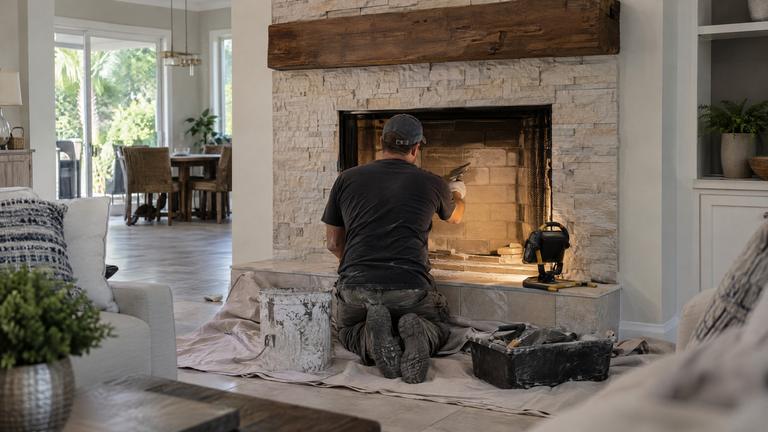
Firebrick and firebox repair for Lake Mann Gardens homes
Back wall cracked in Lake Mann Gardens? Our firebox specialists inspect at no charge and explain the repair before any work.
- Licensed & insured
- Locally run
- Family owned and operated
- Same-day service available



The lining checks we price for Lake Mann Gardens homes
- Masonry or factory-built firebox check
- Loose brick removal and resetting
- Medium-duty refractory mortar for joints
- Curing and first-fire guidance in writing
Firebox repair in Lake Mann Gardens, from brick to mortar
Refractory mortar holds the firebox together
The joints between firebricks need a mortar made for heat. Section R1001.5 of the Florida residential code calls for medium-duty refractory mortar conforming to ASTM C199, the standard used to rate refractory mortars.
Ordinary masonry mortar can crumble and wash out of a firebox joint after repeated fires. Our technicians remove failed joint material and relay or repoint with refractory mortar, and the product we use is written on your job sheet so the next person to look at the fireplace knows what is there.
When the firebox walls need rebuilding
A firebox rebuild goes further than relining. When the masonry behind the lining has cracked, shifted or lost its strength, the walls are taken down and rebuilt with a new lining to the code's requirements.
It is the largest firebox repair, and we only recommend it when the inspection shows the smaller options will not hold. Our estimate explains why, which parts come out, what stays and how the rebuild keeps the depth and opening the fireplace needs.
Where the grate and logs should sit
The grate keeps the fire off the floor and lets air reach it. Pushed hard against the back wall, it holds the hottest part of the fire right on the lining, and logs leaning on the wall concentrate heat in one spot.
We check the grate for size and condition during a firebox visit. A grate that fits the firebox with space at the back spreads the heat more evenly, and it is one of the simplest ways to protect a repaired lining.
Dry, seasoned wood and the firebox
The EPA's Burn Wise guidance tells wood burners to burn only dry, split, well-seasoned wood. Wet wood smolders, and a smoldering fire leaves the firebox damp, sooty and slow to warm.
After a repair, burning dry wood in modest fires is one of the best ways to protect new brick and mortar. If you are unsure about your wood, ask our technician, who can explain what well-seasoned wood looks and sounds like.
The ash chamber below the firebox
On fireplaces with an ash dump, ashes fall into a chamber below the firebox, usually with a cleanout door on the outside of the chimney. When that chamber is full or damp, it can affect the firebox floor above it.
We check the ash dump from the firebox side and ask about the cleanout below. A full chamber should be emptied, cold, before the floor is repaired, and any damage there is noted separately.
Other work in Lake Mann Gardens
-
-
-
-
-
-


Questions about relining and rebuilding
What causes a firebox to crack?
Years of heating and cooling, fires too large for the box, water from above, impact from logs and old repairs with the wrong materials all play a part. Our technicians look for the cause so the repair addresses it.
How often should the firebox be checked?
NFPA 211 calls for fireplaces and chimneys to be inspected at least once a year, and the firebox is part of that check. A yearly look catches worn joints and cracked bricks while the repair is still small.
Request your free estimate
Share the job details and arrange a free inspection with our local team.
- Free inspection
- No hidden fees
- Family owned and operated
Need an answer now? Call (352) 675-6376
Your request is received
Thank you. We will contact you to discuss the job and confirm an appointment.