
Chimney animal removal in Maitland
Nest removal, flue cleanup and a sturdy screened cap for Maitland chimneys, priced in writing with no hidden fees.
- Licensed & insured
- Locally run
- Family owned and operated
- Same-day service available



On the estimate for your Maitland chimney
- Rules that apply to that animal, explained
- Smoke shelf cleared and checked
- Damper operation and seal checked
- Room protected during cleanup
Chimney animal details for Maitland homeowners
An uncapped flue is an open door
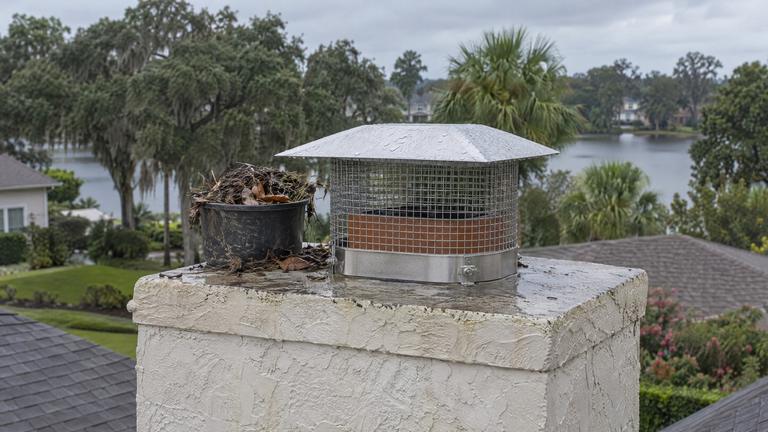
A masonry flue with no cap is open to rain, debris and any animal that climbs or flies to the roof. Many animal problems we see start this way. Capping an empty, clean flue with a screened cap is usually the fix that keeps the chimney empty, and it keeps rain out of the flue as well. We confirm nothing is inside before the cap goes on. An uncapped flue also takes in rain, which is why capping helps the chimney long after the animal problem is solved.
Screen sizes the residential code sets
The Florida residential code, in section R1003.9.2, sets the size of spark arrestor screen openings on masonry chimneys. The openings must not pass a sphere larger than half an inch and must not block a sphere smaller than three-eighths of an inch. That range keeps out birds, bats and squirrels while letting smoke through. Caps we install on masonry flues follow it. A screen with larger openings may look sturdier and still let bats and small birds slip through.
A top-sealing damper as a second barrier
A top-sealing damper is a lid at the top of the flue that closes against a gasket and is opened with a cable from the firebox. When closed, it shuts the flue against animals, rain and outside air. It must be fully open whenever the fireplace is used. For chimneys that animals keep visiting, top-sealing damper installation can add a second barrier alongside a screened cap. Because it seals at the top, it also keeps rain and debris out of the flue while the fireplace is not in use.
How animals get into factory-built chimneys
Factory-built chimneys have a metal pipe with a listed cap on top, running inside a framed chase. Animals get in through a damaged cap into the pipe, or through gaps at the chase cover into the chase itself. Each route needs a different fix. We identify which one the animal used and quote the listed cap, the chase cover work or both. Closing only one of the two routes leaves the other open for the next animal. The cap for the pipe must be the listed one, while the chase cover is made to the chase's own measurements.
Other work in Maitland
-
-
-
-
-


Your Maitland chimney animal questions, answered
Can I clean up the droppings myself?
It is better to leave them. The CDC notes that histoplasmosis spreads through spores in bird and bat droppings when they are disturbed. We remove and bag droppings with care as part of the cleanup.
Why do you check the smoke shelf?
Nest material and droppings often land on the smoke shelf behind the damper, out of sight from the room. We clear it during the cleanup, so debris does not stay in the smoke path.
Request your free estimate
Share the job details and arrange a free inspection with our local team.
- Free inspection
- No hidden fees
- Family owned and operated
Need an answer now? Call (352) 675-6376
Your request is received
Thank you. We will contact you to discuss the job and confirm an appointment.