
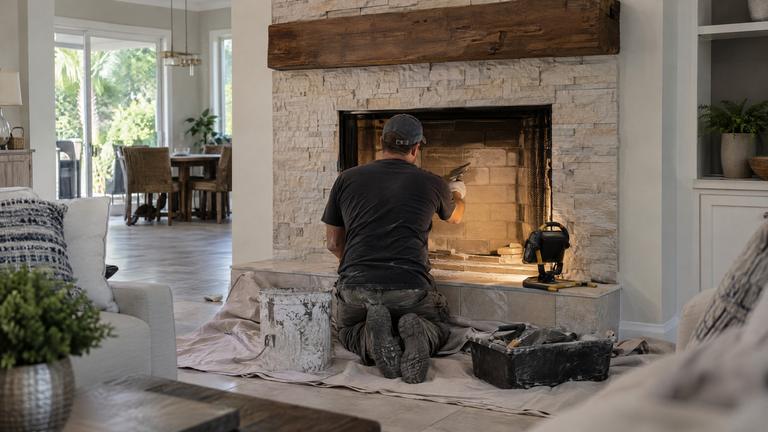
Family-owned firebox repair in Meadow Woods
Brick matched to your lining, joints kept thin and a workmanship warranty on what we lay. Save 10% within 72 hours after the inspection.
- Licensed & insured
- Locally run
- Family owned and operated
- Same-day service available



From tap test to curing guidance
- Raking out and repointing worn joints
- Joint at the hearth edge
- Joint at the facing edge
- Moisture signs and their source, noted separately
From one cracked brick to a new lining
Why the firebox is lined with firebrick
Ordinary building brick is made for walls, and firebrick is made for heat. The Florida Building Code, Residential, section R1001.5, calls for firebox firebrick that conforms to ASTM C27 or ASTM C1261, the standards written for fireclay and firebox brick.
When we replace firebrick, we use brick made to those standards and matched in size to the lining you have. A common red brick set into a firebox may look fine for a season, but it was never meant to take that heat, and our estimate never proposes one.
Side walls and the corners where they meet
Side walls often angle outward toward the room, and the corners where they meet the back wall carry stress from heat moving in two directions. Cracks and open joints in those corners are a frequent finding.
Our technicians check both side walls and all the corners, including where the walls meet the floor. A corner that has opened is rebuilt with firebrick and refractory mortar so the walls work together again, and the estimate names each area we repair.
Relining the firebox
Relining replaces the firebrick lining across one wall or the whole box while keeping the masonry behind it. It makes sense when damage is spread across many bricks and joints, too widespread for spot repairs to last.
Our technicians remove the old lining, check the masonry behind it and lay new firebrick in refractory mortar with thin joints. The estimate states which walls are included, how the floor is handled and how long the new mortar needs before the first fire.
Taking out damaged brick without harming sound brick
A careful repair removes only what has failed. Our technicians cut out damaged brick and joint material with tools sized for the job, so the sound brick around the repair is not loosened in the process.
The opening is then cleaned back to a solid bed before new firebrick goes in. That preparation is the part nobody sees afterward, and it is the part that decides whether a repair lasts.
More than one fireplace in the home
Homes with two fireplaces often see similar wear in both, especially if they were built at the same time and used the same way. A problem found in one is worth checking in the other.
Mention both when you book. Our technician can inspect them on one visit, and the written estimate lists each firebox separately so you can decide what to repair now and what can wait.
Other work in Meadow Woods
-
-
-
-
-


Answers about cracked and loose firebrick
Why can't ordinary mortar be used inside the firebox?
Ordinary mortar is made for normal temperatures and can crumble after repeated fires. The Florida residential code calls for firebrick to be laid with medium-duty refractory mortar, and that is what our crew uses.
Can you just coat over the cracks?
A coating can make a wall look even, but it does not replace a missing brick or restore an eroded joint. Our estimate addresses the brick and joints first and only suggests a coating where the surface underneath is sound.
Request your free estimate
Share the job details and arrange a free inspection with our local team.
- Free inspection
- No hidden fees
- Family owned and operated
Need an answer now? Call (352) 675-6376
Your request is received
Thank you. We will contact you to discuss the job and confirm an appointment.