
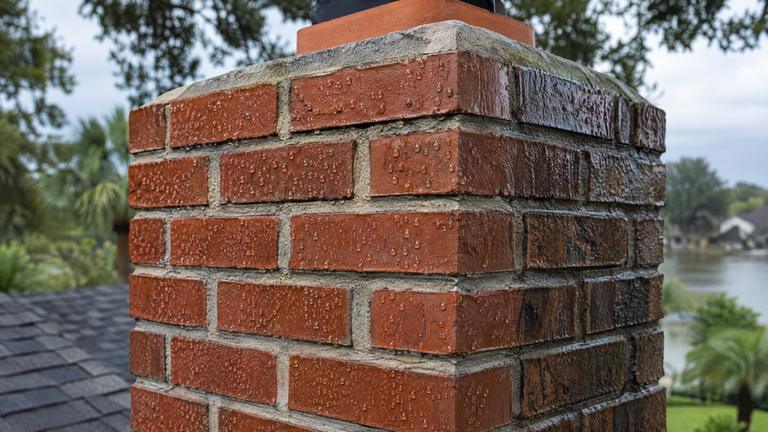
Chimney waterproofing and sealing in Pine Castle
Book your free chimney waterproofing inspection in Pine Castle, then save 10% on work you book within 72 hours after it.
- Licensed & insured
- Locally run
- Family owned and operated
- Same-day service available



Your free waterproofing inspection in Pine Castle looks at
What we examine at the chimney in Pine Castle, so the treatment you approve suits the masonry you have.
- Spalled or cracked brick that needs replacing before treatment
- Flashing and cap findings, priced separately
- Test patch location and what we check on it
- Weather window and drying needs for the product
Our approach to chimney waterproofing in Pine Castle
Before you approve a treatment in Pine Castle, these are worth knowing.
Why cracks get repaired before any repellent
The Brick Industry Association's guidance on colorless coatings says a penetrating repellent rarely holds back water at a crack wider than about 0.02 inch. That is roughly the thickness of a few sheets of paper, so many cracks you can see from a ladder are already past what a clear coat can handle.
Our pros mark each crack during the inspection and decide how it should be repaired, whether that means new mortar, a replaced brick or crown work. The repellent goes on only after those repairs, so it is treating sound masonry instead of being asked to bridge gaps it was never made for.
When an old coating is already on the chimney
Masonry guidance says compatibility with existing treatments has to be settled before a new coat goes on. Reapplying over the wrong layer can cause clouding that is difficult or impossible to remove, and removing an old coating can involve regulated chemicals.
That is why we ask what was used before and look closely at how the surface takes water. An old penetrant may accept a compatible fresh coat. A worn film may need to wear off first. We will not guess, and if we cannot identify a safe path, we tell you so rather than risk the brick.
The brick itself matters
Every brick is made from different clay and fired differently, and those properties affect how a coating performs. Masonry guidance recommends consulting the brick manufacturer before selecting a coating whenever possible, and selecting only coatings intended for clay brickwork.
On most existing chimneys, nobody knows who made the brick. That is where the test area earns its place. We watch how your brick takes the product and what it looks like afterward, and we choose a repellent whose maker lists clay brick as a suitable substrate.
Solar panels close to the chimney
Solar panels near a chimney add glass and framing to the list of surfaces to protect, and they can limit where a ladder or crew can stand. Repellent drift on panel glass is exactly what masonry guidance warns about.
We cover panels in the work area and plan access that does not put weight on them. If panels block access to a chimney face, we note it at the inspection and discuss options. The treatment plan works around your equipment, not the other way around.
Other work in Pine Castle
-
-
-
-
-


Chimney waterproofing questions from Pine Castle
Answers from our specialists in Pine Castle, with no sales pressure.
Do cracks and loose mortar need fixing first?
Yes. Masonry guidance says a repellent rarely seals a crack wider than about 0.02 inch, and open joints let water straight in. We repair those first, let the mortar cure and then treat the sound masonry.
Why not use a glossy sealer on the chimney?
Film-forming products such as acrylics, waxes, stearates and urethanes can stop rain at the face but slow drying from inside. Water that gets behind them can leave a white haze, trapped salts and flaking brick, and masonry guidance discourages them on exterior brick. We use breathable penetrating repellents instead.
Request your free estimate
Share the job details and arrange a free inspection with our local team.
- Free inspection
- No hidden fees
- Family owned and operated
Need an answer now? Call (352) 675-6376
Your request is received
Thank you. We will contact you to discuss the job and confirm an appointment.