
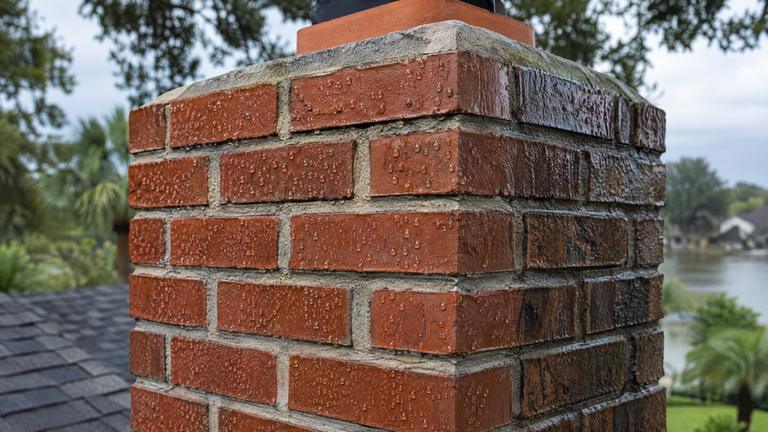
Breathable chimney waterproofing across Richmond Estates
Local specialists seal chimneys in Richmond Estates with repellents made for masonry. Upfront pricing and no hidden fees.
- Licensed & insured
- Locally run
- Family owned and operated
- Same-day service available



Checked before any repellent goes on in Richmond Estates
Four of the points our specialists record on a waterproofing job in Richmond Estates, with upfront pricing on each line.
- Spalled or cracked brick that needs replacing before treatment
- Crown condition and drip edge, listed on its own line
- Which chimney faces receive the repellent
- Workmanship warranty on the application we perform
Chimney waterproofing details that matter in Richmond Estates
Our team in Richmond Estates walks every homeowner through points like these.
The second pass while the first is still wet
For maximum penetration, SaverSystems recommends a wet-on-wet application of its water-base chimney product, retreating the surface within three to five minutes after the first pass. A second coat on dry masonry does not behave the same way.
We work in sections small enough to keep that timing, especially on sunny faces where the surface dries quickly. On porous brick, the second pass fills pores the first one could not reach. On dense brick, we watch closely so the surface is saturated without puddling product on the ledges.
Cleaning up overspray as we go
Makers of masonry repellents direct removing inadvertent overspray from non-target surfaces immediately with soap and water. Left to dry, product on glass, paint or metal can be much harder to take off.
Our crew keeps a bucket and cloths on the roof and at ground level during every application. We check windows, trim, gutters and flashing as each face is finished, not just at the end of the day. When we pack up, we walk the site with you and point out that everything nearby is clean.
Repointing weak joints before treatment
Mortar is usually the first part of a chimney to wear. Joints that are cracked, sandy or recessed let water into the wall, and the Brick Industry Association lists repointing incompletely filled, cracked or disintegrated joints among the repairs a repellent should not replace.
When joints need work, our crew cuts out the weak mortar and repacks it, then leaves it to cure for the time the product maker requires before waterproofing. That work appears on your estimate as tuckpointing, priced on its own, so the treatment line only covers treatment.
Wind-driven rain and cracked masonry
Rain that falls straight down behaves very differently from rain driven sideways by wind. Masonry guidance notes that the effectiveness of penetrating repellents is limited under wind-driven rain, especially where there are cracks or open joints.
That is one more reason we repair joints and cracks before treating. A sound chimney wall with a breathable repellent sheds far more of that sideways rain than a cracked one with a coat over it. The repairs do the heavy lifting, and the treatment helps the masonry between them.
Other work in Richmond Estates
-
-
-
-
-



Learn more about chimney waterproofingRichmond Estates services
Your Richmond Estates chimney waterproofing questions, answered
If your question is not here, our Richmond Estates team is a phone call away.
Can you waterproof a painted chimney?
Usually not with a penetrating repellent. Products like these are made for bare masonry, and makers say not to apply them over paint or glazed brick. We look at the paint's condition and tell you honestly whether to leave it, repair around it or plan something else.
Will you test the product on my chimney first?
Yes. Brick and mortar vary, so product makers and masonry guidance recommend a test area, and the Brick Industry Association suggests at least ten square feet. We pick a face you can see, let the test cure and look at the finish and the way water behaves on it before treating anything else.
Request your free estimate
Share the job details and arrange a free inspection with our local team.
- Free inspection
- No hidden fees
- Family owned and operated
Need an answer now? Call (352) 675-6376
Your request is received
Thank you. We will contact you to discuss the job and confirm an appointment.