
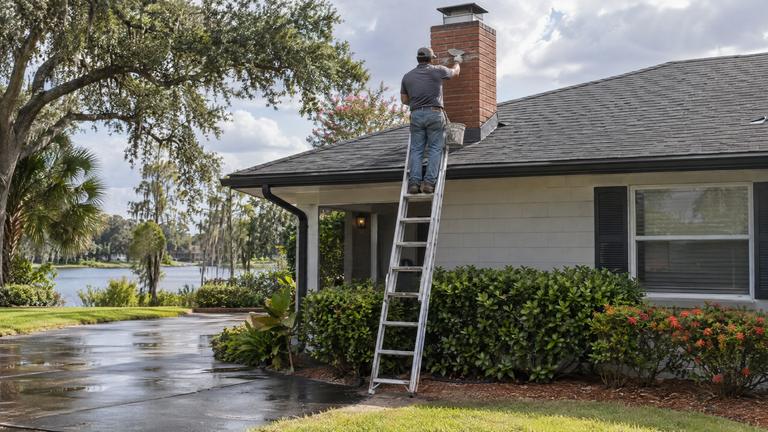
Smoke chamber repair specialists for Richmond Estates homes
Our Richmond Estates fireplace specialists read the chamber shape, the smoke shelf and the damper area before recommending a repair.
- Licensed & insured
- Locally run
- Family owned and operated
- Same-day service available



The chamber estimate for your Richmond Estates home
Take your time with these in Richmond Estates. The free inspection comes with no obligation.
- Chamber top viewed from the flue where access allows
- Wall slope checked against the code limits
- Refractory product named for the parging
- Damper frame joint pointed with refractory mortar
Chamber know-how from our Richmond Estates crew
Short reads that help before you approve chamber repair in Richmond Estates.
What the smoke chamber does above the damper
A masonry fireplace has a wide firebox and a much narrower flue. The smoke chamber is the tapered space between them, rising from the throat and damper to the bottom of the flue. Smoke gathers there and is funneled upward.
Because it sits out of sight, the chamber is easy to forget until something falls onto the damper. Our pros treat it as its own part of the fireplace, with its own findings and its own line on the estimate.
- Collects smoke above the damper
- Narrows the passage toward the flue
- Carries the first flue tile at its top
Firebrick and clay linings inside a chamber
Some smoke chambers are lined. The code allows two linings, firebrick of 2 inches or more that meets ASTM C1261, set in medium duty refractory mortar, or vitrified clay of 5/8 inch or more that meets ASTM C315.
A lined chamber gets a different repair from a bare one. Loose or cracked lining units are reset or replaced and pointed with refractory mortar, and the surface is finished to match. We note the lining type during the inspection and plan the work around it.
Checking for loose or missing brick first
Before a chamber is coated, the masonry has to be sound. The data sheet we follow calls for the chamber to be checked for cracked, loose or missing bricks, failed mortar and obstructions that could prevent correct installation.
Loose units are reset in refractory mortar, missing ones are replaced, and badly broken sections are rebuilt. Those repairs go in before the finish coat, because a smooth coat laid over a moving brick will crack along the same line within a short time.
Reshaping a lopsided chamber
Some chambers lean hard on one side, have a pocket above the damper or narrow unevenly toward the flue. The chamber coating data sheet we follow describes using the material to reshape fireplace smoke chambers, as well as to smooth jagged edges and corbels.
Reshaping means building the coat thicker where the wall needs to come in and thinner where it is already close. We explain what the finished shape should look like, where the limits are and how the work affects curing time.
Heat and movement in chamber masonry
Every fire heats the chamber walls and every cool-down lets them shrink back. Over many years, that repeated movement works on mortar joints and on any earlier patch that was not made for heat.
A refractory coat is made to handle that exposure. Small fires after the repair, while the coat finishes curing, give it a good start. Hot, fast fires that push flames up past the damper are hard on any chamber, new or old, and we mention that at the walkthrough.
Other work in Richmond Estates
-
-
-
-
-
-


Learn more about smoke chamber repairRichmond Estates services
What people in Richmond Estates ask before parging
Short answers from the crew that parges chambers in Richmond Estates. Call with anything else.
Are small cracks in a new chamber coat a problem?
Fine surface crazing can appear after a parged chamber cures or sees its first fires, and one maker describes it as having no functional concern. We look at the coat again at your next inspection, and any real defect in our work is covered.
How often should a repaired chamber be checked?
Under NFPA 211, a chimney, its fireplace and its vents get an inspection every year at a minimum. A parged chamber is part of that yearly check, and we look at the coat, the shelf and the damper each time.
Request your free estimate
Share the job details and arrange a free inspection with our local team.
- Free inspection
- No hidden fees
- Family owned and operated
Need an answer now? Call (352) 675-6376
Your request is received
Thank you. We will contact you to discuss the job and confirm an appointment.