
Family-owned fireplace repair serving Richmond Heights
Our family-owned crew fixes dampers, fireboxes, hearths and doors for Richmond Heights homes, with upfront pricing and no hidden fees.
- Licensed & insured
- Locally run
- Family owned and operated
- Same-day service available



Fireplace repair items we put in writing for Richmond Heights
- Damper plate, frame and full travel
- Facing tile, stone or brick around the opening
- Lintel over the opening and where it bears
- Mantel fixings and distance from the opening
What goes into a fireplace repair that holds
Cracks in firebrick and what they tell us
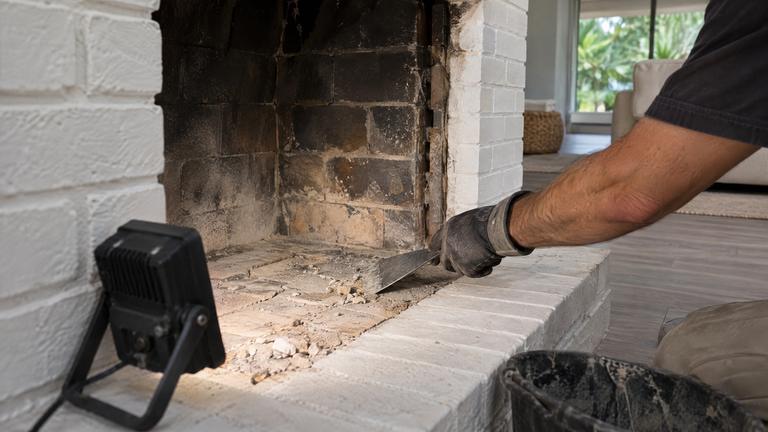
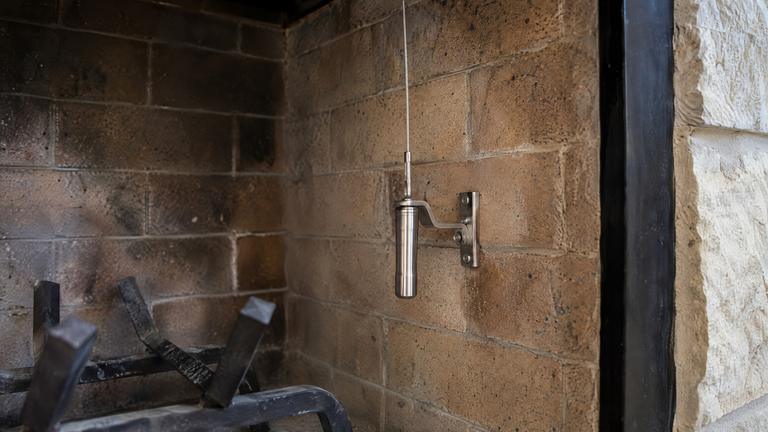
A hairline on the back wall of a firebox is not always a failure. What matters is whether each brick is still whole and tight in its wall. A crack that runs clean through a brick, a piece that moves when pressed or a joint that has fallen out tells a different story.
The Florida Building Code calls for firebrick in a masonry firebox to be laid in medium-duty refractory mortar with thin joints. That is the standard a repair has to meet, which rules out ordinary mortar and the caulk tubes sold for household gaps.
Our technician then sorts the cracks in your Richmond Heights firebox into cosmetic ones, ones that need a targeted firebrick repair and ones that point to a rebuild of the lining. Larger firebox work is written as its own line and handed to our firebox repair service, so the general visit stays focused on diagnosis and the smaller fixes.
Metal trim and hoods on a factory-built face
The metal pieces around a factory-built opening, such as a trim frame, a hood above the opening or grille panels, are often part of the listed system. Some are there for heat or air flow and not only for looks, and the model's manual says which. Take them off for a new look and the fireplace may no longer match what was tested.
Problems tend to appear after a refacing, when a hood is left off, a grille is painted shut or trim is bent to fit new stone. The fireplace may still light and burn, which is why the change goes unnoticed.
On site, the face is checked against the model's manual. We refit or replace the listed trim and reopen air slots that were closed off. Where a finish sits too close to the opening, the estimate says what the manual requires and what has to change, with each listed part named.
A sagging or cracked lintel over the opening
The lintel carries the masonry above the fireplace opening. The Florida Building Code requires it to be noncombustible, with bearing on each end of the opening. Where it sits behind the face, the signs of trouble show in the masonry around it.
Trouble can show as a crack running up from a top corner of the opening or bricks above the opening dropping slightly. Where the lintel is a steel angle, rust can bow it, and water from a leak higher on the chimney may be feeding that rust.
Our technicians look at the lintel, the brick it carries and the ends where it rests. A rusted angle may be cleaned and protected, or it may need replacing with the masonry above supported during the work. That is a bigger job, and the estimate explains the steps and the face repair that follows.
Starting a fire without gasoline or charcoal fluid
EPA wood-burning guidance says never to start a fire with gasoline, kerosene or charcoal starter. In a fireplace, a flare-up from any of them can scorch the hearth, the face and anyone standing close.
The same guidance points to newspaper, dry kindling or all-natural fire starters instead. A small, well-built fire lit that way catches steadily, with the damper fully open before the first match.
If a repair visit finds scorching that looks like an accelerant was used, our technicians explain it without judgment and repair the damaged parts. Hearth tile, door glass and facing near the opening are where that damage tends to show, and each is written up on its own line. Your written record includes a short note on lighting the fire the way EPA describes, with newspaper and dry kindling, which protects the repair along with everyone in the room.
Other work in Richmond Heights
-
-
-
-
-
-


Learn more about fireplace repair and serviceRichmond Heights services
Related fireplace repair work
-
-
-
-


Common questions about fireplace work
What if the part for my model is no longer made?
We check the maker's service information and parts channel first, because a replacement is sometimes still listed. If the part is truly gone, you get the options in writing, a larger repair the maker supports or a new unit, since a look-alike part cannot go into a listed fireplace.
Should I light a fire to show you the problem?
No. Leave the fireplace cold and describe what you saw, when it happened and what the fire was like. Our technician checks it cold, which is safer, and your description fills in how the fire behaved.
Request your free estimate
Share the job details and arrange a free inspection with our local team.
- Free inspection
- No hidden fees
- Family owned and operated
Need an answer now? Call (352) 675-6376
Your request is received
Thank you. We will contact you to discuss the job and confirm an appointment.