
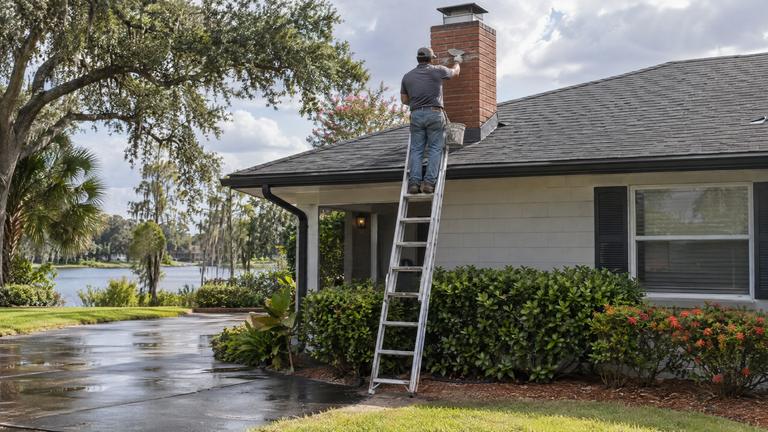
Your local chimney repair team in Rowena Gardens
Our family-owned crew repairs crowns, flashing, brick, liners and chases for Rowena Gardens homes, with every price in writing first.
- Licensed & insured
- Locally run
- Family owned and operated
- Same-day service available



The lines on your chimney repair quote
- Mortar joints to repoint, marked by area
- Damper plate, frame and handle
- Air space and fireblocking at attic and floors
- Chimney height against the code's termination rule
How we repair chimneys in Rowena Gardens
Insulation and a metal chimney in the attic
Where a factory-built chimney passes through an insulated ceiling, the Florida Building Code calls for an insulation shield that holds insulation back at the clearance the chimney maker specifies. In an attic, the shield has to stand above the insulation and be secured so it cannot shift.
Attic work is where this gets undone. Blown insulation is topped up and piles against the pipe, a shield gets knocked loose or wiring is run along the chimney. DuraVent's instructions for one of its chimneys say never to fill the required air space with insulation or any other material, and to keep wiring and building insulation away from all chimneys.
Our technicians check the attic run whenever the chimney is part of a repair. They look for the three things below, and anything out of place goes on the estimate with its fix.
- A shield in place where the pipe enters the attic
- Insulation held back from the pipe on every side
- No wiring, boxes or stored items against the chimney
After a chimney fire, keep the chimney out of use
Creosote is a black or brown combustible residue that forms when smoke condenses on the cooler walls of a flue. DuraVent's chimney instructions describe ignited creosote as an extremely hot fire, and they say not to use the chimney again until it has been inspected for possible damage.
If a fire is burning in the chimney now, get everyone out of the house and call 911. Nothing about the flue matters until the fire department says the house is safe.
Once it is out, the flue stays unused until that inspection is done. It looks for cracked or displaced flue tiles, open joints, damage to the smoke chamber and damper, heat damage at the top and anything scorched where the chimney meets framing. Our chimney inspection service handles that work, and each repair it finds is priced on a written estimate.
Smoke in the room points to a problem
EPA wood-burning guidance says a properly installed, correctly used appliance should make very little smoke, and that smoke you regularly see or smell means you may have a problem. An open fireplace that puffs smoke out of the opening each time it is lit fits that description.
The causes run from simple to serious. At one end sit a damper that is not fully open and wet or green wood. At the other sit a flue blocked by debris or a nest, a damaged smoke chamber or a chimney too short for the roof around it. Until the cause is found, stop using the fireplace.
Finding the cause means checking the damper, the smoke chamber, the flue and the height of the chimney in turn. For homes in Rowena Gardens, the cause is traced to the part responsible, and the estimate names the fix, whether that is a damper repair, clearing a blockage or a change at the top.
How a chimney is tied to the house
A chimney built against an outside wall is meant to be fastened to it. Brick Industry Association guidance says single-wythe chimneys should be attached to the structure, generally with corrosion-resistant metal ties.
Those ties sit out of sight. When they rust through or were never installed, the only signs may be a gap opening between chimney and siding, a crack running up the line where the two meet or trim pulling away. The same guidance has the layers of a chimney more than one wythe thick joined with metal wire ties where the masonry itself does not lock them together, so ties can matter inside the chimney as well as at the wall.
Where anchors or ties have failed, BIA maintenance guidance describes proprietary retrofit anchors set through small holes drilled in the masonry, usually in a mortar joint, and attached to the structure behind, with the anchor maker consulted on each product. It says such anchors improve the stability of the masonry. Our crew in Rowena Gardens checks the joint between chimney and house during the inspection and writes any re-anchoring into the estimate.
Other work in Rowena Gardens
-
-
-
-
-


What homeowners ask about chimney repair
Can we keep using the fireplace until the repair is done?
It depends on what is damaged. A cracked flue lining, a damaged smoke chamber or a damaged firebox means no fires until the repair is finished. Outside damage lower down, such as a worn joint, may not affect use, and the estimate states which case applies to your chimney.
Do I need to go up on the roof to show you the problem?
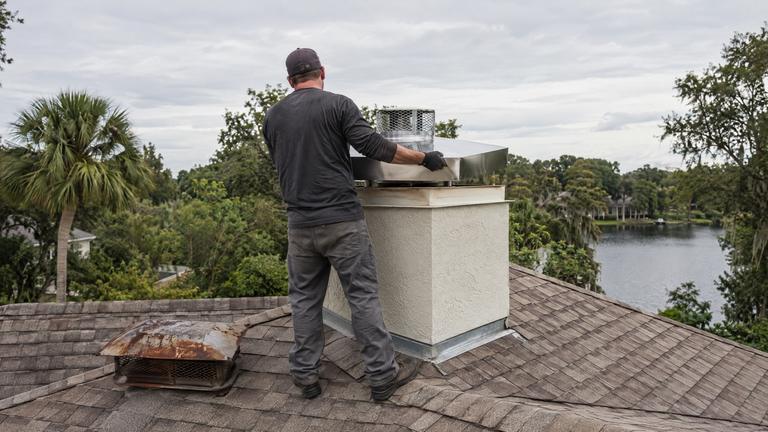
No, please stay off the roof. Tell us what you noticed from inside and from the ground, such as a stain, fallen debris or a leaning cap. Our crew handles the access and the close look during the free inspection.
Request your free estimate
Share the job details and arrange a free inspection with our local team.
- Free inspection
- No hidden fees
- Family owned and operated
Need an answer now? Call (352) 675-6376
Your request is received
Thank you. We will contact you to discuss the job and confirm an appointment.