
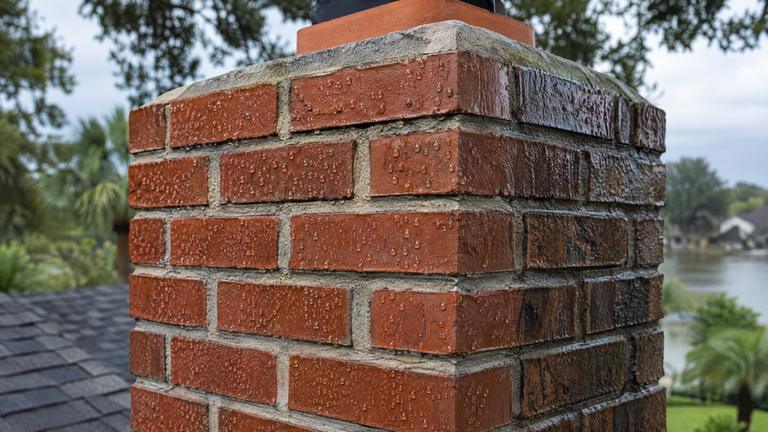
Family-owned chimney waterproofing in South Orange
We check the joints, the crown and the brick in South Orange before any product goes on. 100% satisfaction guaranteed on the work we do.
- Licensed & insured
- Locally run
- Family owned and operated
- Same-day service available



Waterproofing details we put in writing in South Orange
These items keep a waterproofing job in South Orange from sealing in a problem that needed a repair.
- Spalled or cracked brick that needs replacing before treatment
- Which chimney faces receive the repellent
- Product and application details kept for your records
- Areas we recommend leaving untreated, and why
Before a repellent goes on chimneys in South Orange
How the job runs in South Orange, and where your choices come in.
How deep a penetrating repellent goes
Penetrating repellents work below the surface instead of on it. Masonry guidance puts their depth at up to about three-eighths of an inch, and individual products vary with the porosity and moisture of the masonry at the time of application.
That depth is why a penetrant tends to hold up under sunlight better than a surface film, and why it leaves the look of the chimney largely unchanged. It is also why surface prep matters. Dirt, salt and old coatings in the pores block the product from getting to where it needs to be, so we clean first.
Painted and glazed brick are a different job
Penetrating repellents need to soak into bare masonry. Chimney repellent labels can be blunt on this point, and at least one maker says not to apply its product to painted or glazed brick or tiles, and masonry guidance notes that penetrants are typically incompatible with film-forming coatings already on the wall.
If your chimney is painted, we look at the condition of the paint and the brick under it. Sometimes the right advice is to leave a sound painted chimney alone and repair around it. Sometimes the coating is failing and trapping water. Either way, we explain the options instead of spraying over a surface the product cannot enter.
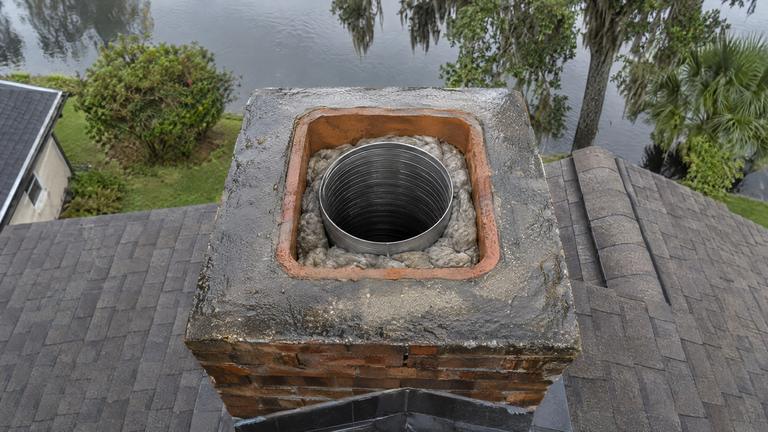
The cap keeps rain out of the flue
A chimney without a cap takes rain straight down the flue. That water ends up in the firebox, on the damper or in the smoke chamber, and it has nothing to do with the brick faces a repellent treats.
When water shows up inside the fireplace, we check the cap before anything else. A missing or damaged cap is written up as its own item. Waterproofing the outside of the chimney is worth doing only when the water problem is really absorption through the masonry.
Treatments stay on the outside
Exterior masonry repellents are made for the outside of above-grade masonry. One widely sold chimney repellent, ChimneySaver water-base, is labeled as not intended for interior use or for resisting water under pressure.
So we do not spray anything inside the firebox, the smoke chamber or the flue. If water is reaching the inside of the chimney, the cause is somewhere we can repair, such as the cap, the crown, the flashing or an open joint, and that repair is what goes on your estimate.
Other work in South Orange
-
-
-
-
-
-


Your South Orange chimney waterproofing questions, answered
If your question is not here, our South Orange team is a phone call away.
Is it ever too hot to treat the chimney?
Yes. ChimneySaver water-base, for example, asks for surface and air between 40 and 100 degrees Fahrenheit for three hours after it goes on, and a chimney face in afternoon sun runs hotter than the air. On hot days we treat in cooler hours or on shaded faces so the product soaks in and cures properly.
Our chimney is new. Does it need a repellent?
Usually not. Masonry guidance does not recommend repellents on newly built brick veneer, and well-built brickwork handles water on its own. A new chimney that takes water points to the crown, the flashing or joints that were not filled, and those get checked first.
Request your free estimate
Share the job details and arrange a free inspection with our local team.
- Free inspection
- No hidden fees
- Family owned and operated
Need an answer now? Call (352) 675-6376
Your request is received
Thank you. We will contact you to discuss the job and confirm an appointment.