
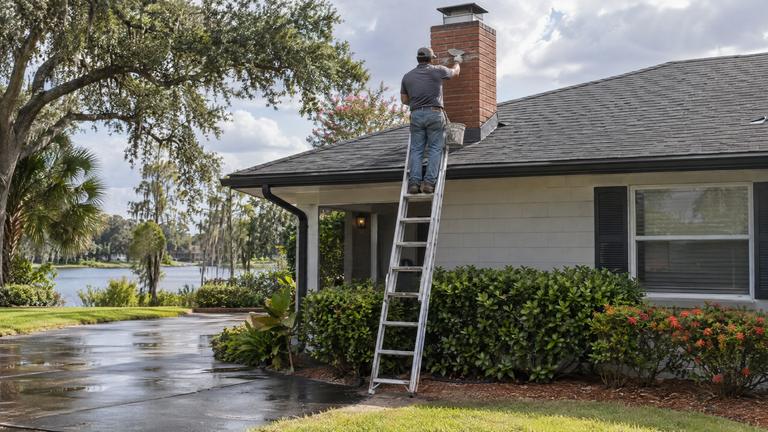
Chimney repair with a free inspection in Timberleaf
Leaks, loose brick or a cracked crown? We trace the damage to its source and repair it properly.
- Licensed & insured
- Locally run
- Family owned and operated
- Same-day service available



Every repair named before work begins
- Base flashing and counterflashing at the roof line
- Cricket on the uphill side of a wide chimney
- Spalled or broken brick to replace
- Items for an engineer's evaluation, listed separately
How we repair chimneys in Timberleaf
Base flashing and counterflashing work as a pair
Where a chimney passes through the roof, two layers of metal keep water out. Base flashing goes in first. It turns up the face of the chimney and runs out along the roof, and the roofing laps over it, so water on the roof flows across the metal rather than into the joint.
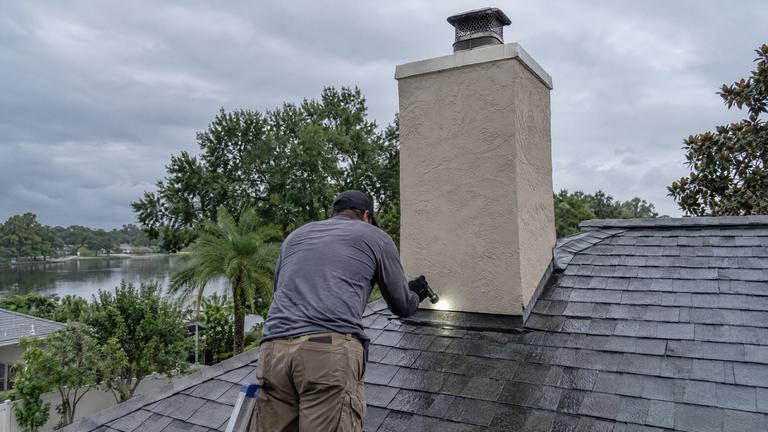
Counterflashing comes second. It is set into the chimney masonry and laps down over the top edge of the base flashing, covering the gap where that layer meets the brick. BIA guidance has the counterflashing lap the base flashing by at least three inches, while the Florida Building Code requires counterflashing on a shingle roof to be corrosion-resistant metal of a set minimum thickness.
When either layer is missing, bent, loose or rusted, water can find its way behind the other. The fix belongs to our chimney flashing repair service, and the estimate says which layer failed and which one stays.
Every masonry chimney needs a sound lining
The Florida Building Code says masonry chimneys shall be lined, and that the lining must suit the type of appliance connected, following that appliance's listing and instructions. The lining is the inner passage the smoke travels through, and it keeps smoke and flue gases inside the flue rather than in the brick around it.
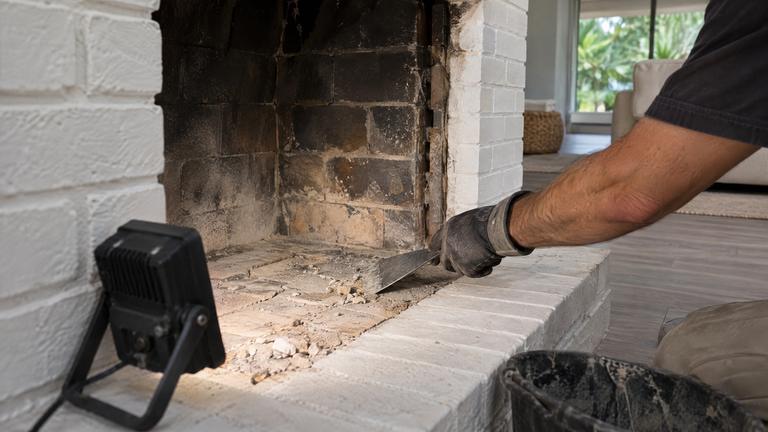
Some chimneys were built without one, and others have a lining that has cracked, shifted or lost pieces. From the room you rarely see it. The clues tend to be indirect, like tile fragments in the firebox or smoke where it should not be.
Because the code requires a lining, a flue without one, or with a broken one, stays out of use until it is repaired. On homes in Timberleaf, our crew checks the lining from the firebox and from the top, and the estimate says whether the flue needs repair, relining or nothing at all.
Checking the chimney after a fallen limb or strong wind
A branch that lands on the roof, or wind strong enough to move patio furniture, can reach the chimney too. The damage is not always obvious from the doorstep, and the roof is no place to go looking. Debris can also drop into an open flue. The yard and an upstairs window show a lot.
Keep people clear of the area below any loose pieces and leave the fireplace unused if the top looks damaged. Our crew checks the chimney from the roof and down the flue, and the written estimate covers the damage that is really there, not a list of guesses. Before the visit, note any of these from the ground.
- A cap or chase top that sits tilted or is gone
- Brick, stone or stucco pieces on the roof or the ground
- Flashing lifted or bent where the chimney meets the roof
- A branch still resting against the chimney
How a chimney is tied to the house
A chimney built against an outside wall is meant to be fastened to it. Brick Industry Association guidance says single-wythe chimneys should be attached to the structure, generally with corrosion-resistant metal ties.
Those ties sit out of sight. When they rust through or were never installed, the only signs may be a gap opening between chimney and siding, a crack running up the line where the two meet or trim pulling away. The same guidance has the layers of a chimney more than one wythe thick joined with metal wire ties where the masonry itself does not lock them together, so ties can matter inside the chimney as well as at the wall.
Where anchors or ties have failed, BIA maintenance guidance describes proprietary retrofit anchors set through small holes drilled in the masonry, usually in a mortar joint, and attached to the structure behind, with the anchor maker consulted on each product. It says such anchors improve the stability of the masonry. Our crew in Timberleaf checks the joint between chimney and house during the inspection and writes any re-anchoring into the estimate.
Other work in Timberleaf
-
-
-
-
-
-


Your chimney repair questions, answered
What should I look for in a chimney repair company?
Look for a company that finds the cause before quoting and names each damaged part in writing. You should see the fix, the material and the price for every line, and nothing should start until you approve. Our family-owned team works that way, and the inspection that begins it is free.
Is the inspection really free, with no obligation?
Yes. You pay nothing for the inspection or the written estimate, and going ahead is entirely your call. If you do approve the work within 72 hours after the inspection, 10% comes off.
Request your free estimate
Share the job details and arrange a free inspection with our local team.
- Free inspection
- No hidden fees
- Family owned and operated
Need an answer now? Call (352) 675-6376
Your request is received
Thank you. We will contact you to discuss the job and confirm an appointment.