
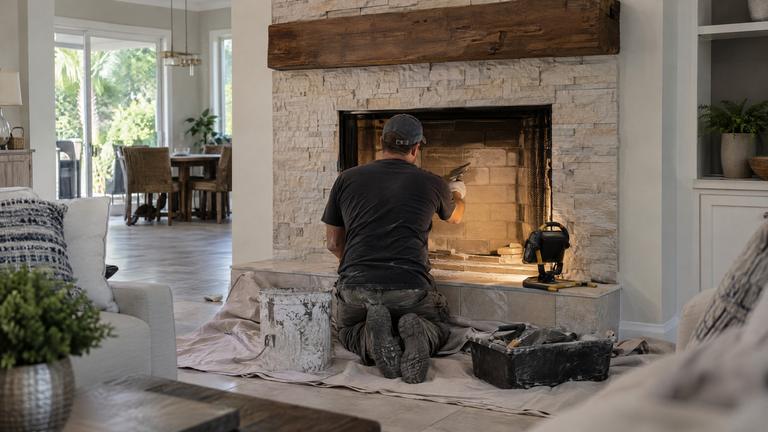
Honest chimney chase repair for Westfield homes
Framing, sheathing, barrier, flashing and finish, each priced on its own line before a single board comes off.
- Licensed & insured
- Locally run
- Family owned and operated
- Same-day service available



Siding to framing, what gets priced
- Seam and flashing where the chase meets the house
- Air space around the chimney pipe kept clear
- Cover replacement listed as its own line
- Ladder, roof anchor or scaffold access
What goes on inside a chase repair in Westfield
Carrying the barrier to the top of the chase walls
The top of a chase is where the barrier often goes wrong. Florida's code, in R703.2, calls for the barrier to run continuous to the top of walls and to be finished at penetrations so the wall stays weather-resistant. On a chase, that top edge sits right under the metal cover.
If the barrier stops short of the top plate, water that gets past the cover edge lands on bare sheathing. If it ends in a way that lets water track behind it, the result is the same.
With the upper siding off a chase in Westfield, our crew runs the barrier up to the top plate and laps it so water sheds onto it, not behind it. That detail disappears once the siding is back, which is why it gets checked before the first board goes on.
Vinyl siding on a chase and room to move
Vinyl siding shows up on plenty of chases because it is light and easy to match. It moves as it heats and cools, and how it is nailed has to allow for that movement. Under R703.11.1, vinyl siding and its accessories go on following the siding maker's instructions.
Vinyl nailed too tight can buckle and pull away at the corners, opening gaps for rain. It also hides what is behind it, so a chase can look fine while the sheathing underneath has gone soft. A panel that has cracked or pulled loose at a corner is the usual first clue.
Our crew removes and reuses vinyl where the panels are sound and rehangs everything the way the maker spells out. For homes in Westfield, the estimate notes whether matching panels are still available. Broken pieces are cut out and replaced without stripping the whole wall where the panels allow it.
Siding boards and nails working loose
Nail heads backing out, boards that rattle in wind and siding that has slipped at the corners all point to a problem behind the finish. Nails hold in firm wood. When the sheathing and studs soften, the nails lose their grip and the siding moves. Vinyl nailed too tight can look loose for a different reason, which is why we check how it hangs.
Renailing loose boards into soft wood only holds for a short time. The new nails pull out the same way the old ones did. Longer nails driven through soft sheathing into soft studs fare no better, and they risk reaching toward the air space inside.
What each loose board was fastened into decides the fix. If the wood behind is firm, the siding is refastened with corrosion-resistant nails. If it is soft, the board comes off and the wall behind it is repaired first. A chase in Westfield can have both cases on different faces, so the answer comes face by face.
Old patch jobs that hide rot
Many chases have been patched before. Caulk smeared over split siding, roofing tar along the base, a coat of paint over soft wood or a strip of trim nailed over a gap can all hide damage for a while. Some of these fixes went on quickly after a storm, and others were left by a previous owner.
The patch often traps water and makes the rot behind it worse. Tar at the base can block the drainage path, and a trim strip over a split can hold water against the board.
Our technicians look closely at old repairs and probe around them. When a patch is hiding soft wood, we take it off and repair what is behind it. Each old patch we plan to remove gets its own line on your Westfield estimate. If an old patch is sound and covers sound wood, it can stay.
Other work in Westfield
-
-
-
-
-
-


Before you book chase repair in Westfield
Will I be able to use my fireplace during the repair?
No. While the chase is open, shields, firestops and the top may be off, so the fireplace stays out of use. We tell you when it is ready again, which is after the chase is closed and the listed parts are back in place.
How long will my chase be open to the weather?
That depends on how much of the wall comes off and on curing time if the finish is stucco. We give you the plan at the start, and any open section is covered before the crew leaves each day.
Request your free estimate
Share the job details and arrange a free inspection with our local team.
- Free inspection
- No hidden fees
- Family owned and operated
Need an answer now? Call (352) 675-6376
Your request is received
Thank you. We will contact you to discuss the job and confirm an appointment.