
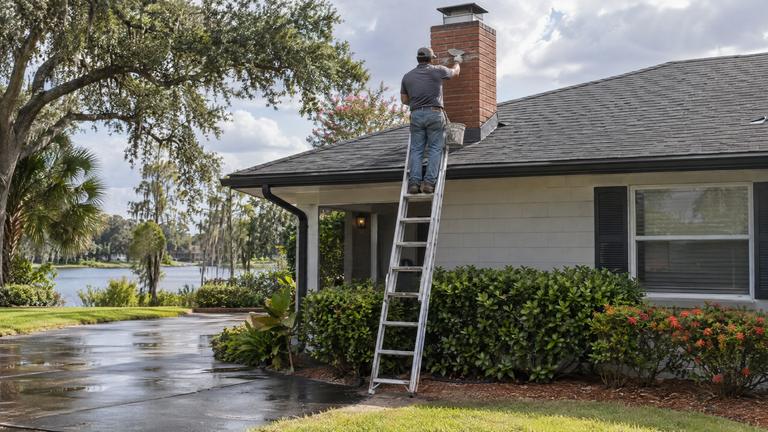
Chimney repair with a free inspection in Conway
Leaks, loose brick or a cracked crown? We trace the damage to its source and repair it properly.
- Licensed & insured
- Locally run
- Family owned and operated
- Same-day service available



The lines on your chimney repair quote
- Crown condition, slope and drip edge
- Cleanout door and any stovepipe entry
- Listed replacement parts for factory-built systems
- Items for an engineer's evaluation, listed separately
What a lasting chimney repair involves
A chimney with more than one flue
Some chimneys carry two or more flues, one for the fireplace and others for a second fireplace or an appliance. Under the Florida Building Code, masonry wythes separate adjacent flue linings, built into the chimney walls, with an exception for two flues venting a single appliance.
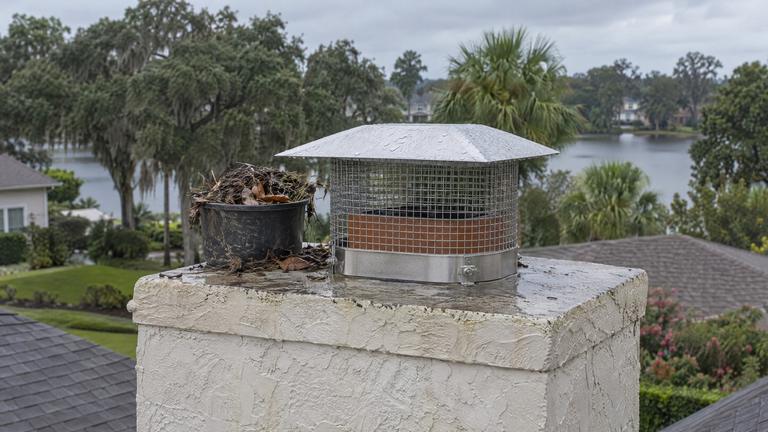
Each flue brings its own top detail, and the masonry between flues cannot be seen from the roof, so every flue is checked from its own top. A cap over one flue with its neighbor left open still lets rain into the chimney.
Every flue gets its own findings on the estimate. That makes it clear which flue a repair belongs to, what that flue serves and whether a problem in one affects the use of the other.
- A liner standing above the crown
- Its own caulked bond break at the crown
- A cap that covers the flue it is meant to protect
- The top of the wythe beside it, as far as it can be seen
Step flashing on a shingle roof
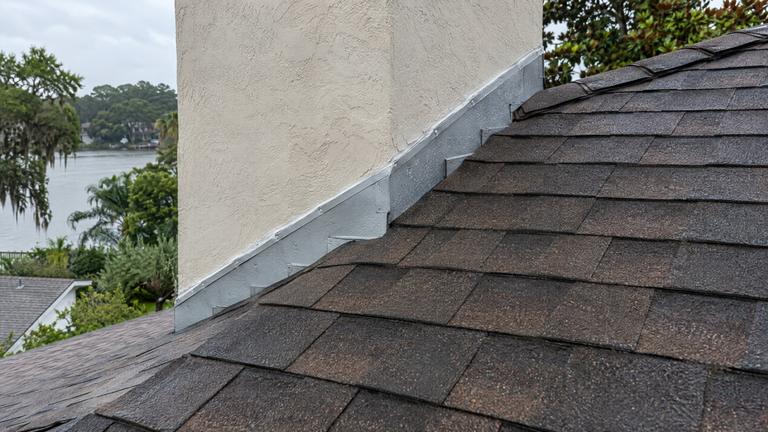
On an asphalt shingle roof, the sides of a chimney are flashed with the roofing. The Florida Building Code allows flashing against a vertical sidewall by the step-flashing method or with continuous L flashing, and it sends chimney flashing on a shingle roof to the shingle manufacturer's instructions.
Step flashing is a run of short bent pieces, each tucked in with a course of shingles and turned up the chimney, so every piece sheds water onto the shingle below it. Continuous L flashing is one long angle along the side instead. Where the code spells out an L flashing method, it starts the flashing at the lower part of the roof so every metal lap sheds water.
The shingle maker's instructions control the details, and our crew follows the ones for the shingle on your roof. Your estimate spells out the method, the metal and how the counterflashing will lap over it.
Flashing metal that lasts
Flashing lives in the wettest spot on the roof. BIA guidance notes that corrosion-resistant sheet metal flashing is required by most building codes, and the Florida Building Code requires metal flashing at wall and roof intersections and around roof openings to be corrosion resistant, with a minimum thickness for each kind of metal.
BIA also says quality flashing materials should be specified because replacement may be expensive and troublesome. Replacing it means cutting out the joints that hold the counterflashing and working the roofing back around the chimney, so a thin or poor metal that fails early can cost far more than it saved.
Our crew uses corrosion-resistant metal at or above the code's minimum thickness. The metal is named on the estimate, so you know what is going into the one part of the chimney nobody wants to open twice.
Smoke in the room points to a problem
EPA wood-burning guidance says a properly installed, correctly used appliance should make very little smoke, and that smoke you regularly see or smell means you may have a problem. An open fireplace that puffs smoke out of the opening each time it is lit fits that description.
The causes run from simple to serious. At one end sit a damper that is not fully open and wet or green wood. At the other sit a flue blocked by debris or a nest, a damaged smoke chamber or a chimney too short for the roof around it. Until the cause is found, stop using the fireplace.
Finding the cause means checking the damper, the smoke chamber, the flue and the height of the chimney in turn. For homes in Conway, the cause is traced to the part responsible, and the estimate names the fix, whether that is a damper repair, clearing a blockage or a change at the top.
Other work in Conway
-
-
-
-
-
-


Your chimney repair questions, answered
Can we keep using the fireplace until the repair is done?
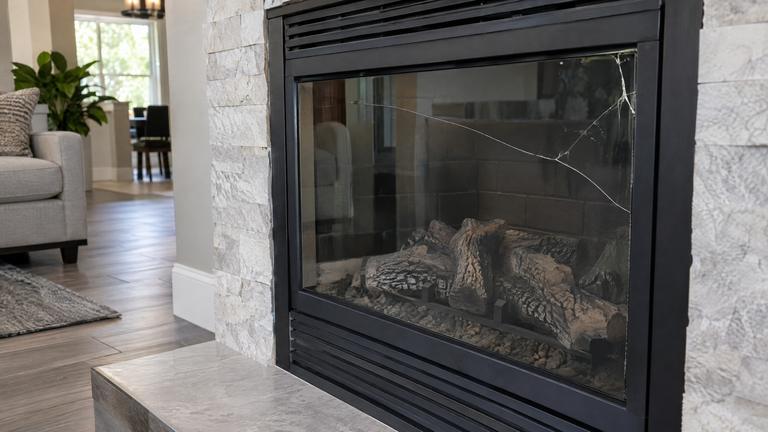
It depends on what is damaged. A cracked flue lining, a damaged smoke chamber or a damaged firebox means no fires until the repair is finished. Outside damage lower down, such as a worn joint, may not affect use, and the estimate states which case applies to your chimney.
How do I set up a chimney repair visit?
Call (352) 675-6376 or use the form, and tell us what you see and where on your Conway home. Same-day visits are available when the schedule allows. The visit starts with a free inspection, and you get a written estimate before any repair begins.
Request your free estimate
Share the job details and arrange a free inspection with our local team.
- Free inspection
- No hidden fees
- Family owned and operated
Need an answer now? Call (352) 675-6376
Your request is received
Thank you. We will contact you to discuss the job and confirm an appointment.