
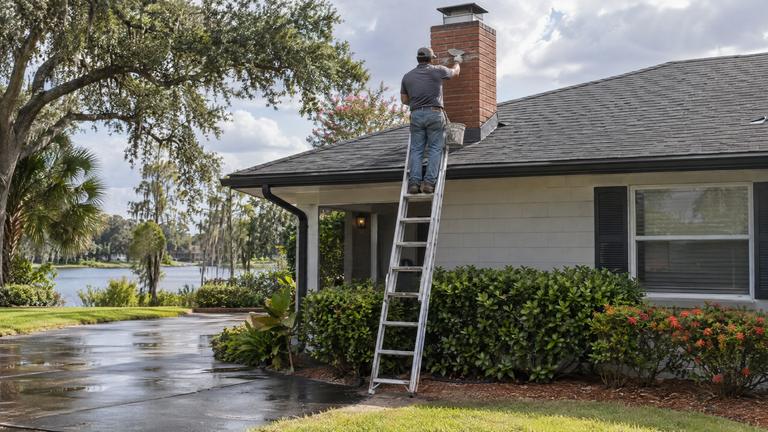
Family-owned chimney repair serving Edgewood
Water, heat and movement damage repaired in the right order for your Edgewood home.
- Licensed & insured
- Locally run
- Family owned and operated
- Same-day service available



Chimney repairs priced one part at a time
- Base flashing and counterflashing at the roof line
- Mortar joints to repoint, marked by area
- Cracks mapped by location and pattern
- Stucco or stone finish and the backing behind it
Repairs that fit the way your chimney is built
Reading cracks in chimney masonry
Cracks in a chimney fall into two very different groups. Hairline cracks in mortar joints and thin gaps where mortar has let go of the brick are maintenance items, and BIA guidance lists both among the conditions that call for repointing.
The second group looks different. Cracks that run through several bricks, cracks that climb in a stepped or diagonal line and masonry that has moved out of plane are conditions BIA maintenance guidance treats as structural. It says issues like these generally warrant an investigation by a professional engineer to find the cause and the right repair.
Filling a structural crack with mortar changes how it looks and does nothing about why it opened. When the first group turns up, it is priced as joint repair. When the second group turns up, the estimate says so in plain words and recommends an engineer's evaluation before any structural work is priced.
Why caulk at the roofline keeps failing
A line of roofing cement or caulk along the base of a chimney often marks a leak someone has already tried to stop. It may slow water for a while, but it does not take the place of the flashing that belongs at that joint.
The difference is in how each one handles water. Flashing works by overlapping, each piece lapping over the one below so water runs off it. A bead of caulk works only while it stays stuck to both surfaces, and it has no lap to fall back on. Once the bond breaks, water gets in behind the bead.
Where layers of old caulk cover the roofline, enough of it comes off to show what is underneath. Missing or failed flashing then goes on the estimate as flashing work, and chimneys in Edgewood do not simply get another bead on top of the old ones.
The label on a relined flue
When a flue is relined with a material outside the standard list in the Florida Building Code, the code asks for a permanent label in plain view close to where the connector enters the chimney. It names the type of appliance and the fuel the flue is for, and warns against connecting anything else.
The label matters more later than on the day of the install. It tells the next buyer, home inspector or installer what the flue was built for. Without it, someone may connect a different appliance to a liner that was never meant for it, or assume a lining suits a new appliance when it does not.
If your chimney was relined and the label is missing or unreadable, it is worth putting back. Our technicians identify the lining where it can be seen and confirm what it serves. A replacement label goes on the estimate alongside any other flue repair, and if the lining cannot be identified, the estimate says so.
The air space between chimney and framing
A masonry chimney is not supposed to touch the wood around it. The Florida Building Code requires an air space between the chimney and combustible material, larger for a chimney inside the house or within an exterior wall than for one entirely outside it. That space may not be filled with anything except the fireblocking the code calls for.
A renovation can close that gap without anyone noticing. Trim and sheathing edges may meet the chimney only where they sit far enough from the flue lining, which the code also spells out.
Our crew looks at the chimney where it passes floors, ceilings and the attic whenever it is part of a repair. Anything crowding it, like the examples below, goes on the estimate with what it takes to restore the space.
- Drywall butted tight against the brick
- Paneling or shelving fixed straight to the chimney
- New flooring or trim laid hard against the chimney face
Other work in Edgewood
-
-
-
-
-


What Edgewood homeowners ask about chimney work
What happens when the chimney has several problems at once?
We list each problem on one written estimate and put them in order, safety items first, then anything letting water in, then finish work. You can approve everything together or plan it in phases. Items that have to be done together are marked that way.
Do you repair factory-built metal chimneys as well as brick ones?
Yes. A factory-built chimney is a listed system, so repairs use the maker's listed parts and follow its installation instructions, as the Florida Building Code requires. Masonry chimneys are repaired to the code's masonry rules, and the estimate says which approach applies.
Request your free estimate
Share the job details and arrange a free inspection with our local team.
- Free inspection
- No hidden fees
- Family owned and operated
Need an answer now? Call (352) 675-6376
Your request is received
Thank you. We will contact you to discuss the job and confirm an appointment.