
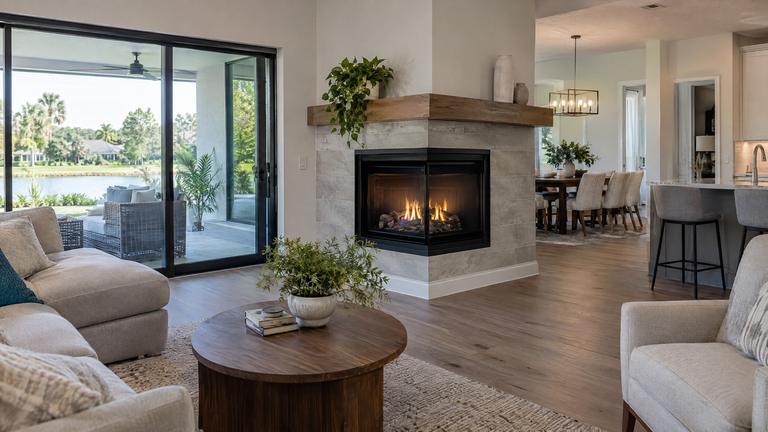
Gas fireplace venting specialists for Lake Richmond
A vent run built from the manual and tested with the fireplace burning before we pack up. Family owned, locally owned and working in Lake Richmond.
- Licensed & insured
- Locally run
- Family owned and operated
- Same-day service available



Checked on every vent visit in Lake Richmond
Each point below is measured or checked at your Lake Richmond home and matched to the fireplace manual before it reaches your estimate.
- Vent type confirmed as direct vent or B-vent
- Rise or level run of horizontal pipe against the manual
- Glass door seal and latches on direct-vent units
- Parts of the run we could not reach, stated in writing
Gas fireplace venting details that matter in Lake Richmond
Vent details from the family-owned crew that works on gas fireplaces across Lake Richmond.
A sealed firebox that takes its air from outdoors
A direct-vent gas fireplace pulls every bit of its combustion air in from outdoors through the vent pipe, as one maker's manual puts it, and sends the exhaust back out the same route. On most units the pipe is two pipes in one, with exhaust in the smaller inner pipe and fresh air moving in the space around it.
Because the room's air plays no part in the fire, the glass front is part of the seal too. Our pros treat the cap, the pipe and the glass as one system and check all three before blaming any single part.
Soffits and overhangs above the cap
An overhang above a sidewall cap can trap exhaust against the house. One direct-vent manual sets 18 inches between the cap and a ventilated soffit that sits within 2 feet of the cap's centerline, and 12 inches below an unventilated soffit.
Ventilated soffits have openings into the attic, which is why they get the larger number. Our crew checks which kind of soffit is above your cap and measures the gap before any recommendation.
Offsets and horizontal runs in B-vent
Natural draft needs the pipe to keep climbing. One B-vent fireplace manual keeps every horizontal run shorter than half the total vent height, measuring pipe center to pipe center, and wants each run to rise at least 1/4 inch per foot, never level and never downhill.
Too much offset is also the first cause in that manual's list for poor draft. Our pros check the slope of every horizontal section they can reach and compare the total offset with the height of the whole vent.
Vent pipe hidden in walls and chases
Most of a gas fireplace vent runs where nobody can see it, behind drywall, stone and roofing. A visual inspection covers the cap, the connection at the fireplace and any section reachable from an attic or access panel.
When a symptom points to a hidden section, our pros explain where an opening would be needed, what the finish repair involves and what it costs, as separate lines. You decide whether to open the wall, with the facts in front of you.
Testing the fireplace after vent work
A vent repair is finished only when the fireplace runs well on it. After the work, our technicians light the unit, watch the flame against the manual's description and let it run long enough to see a steady burn and a normal shutdown.
Any gas connection that was disturbed is leak tested with a soap solution or an approved leak test spray, as manuals direct, and never with an open flame. You see the fireplace running before we leave.
Other work in Lake Richmond
-
-
-
-


- Fireplace InstallationPlan the fireplace before opening the wall.
- Fireplace RestorationBring an unused fireplace back with a coordinated plan.
Learn more about gas fireplace ventingLake Richmond services
Fireplace vent questions from Lake Richmond, answered
Questions Lake Richmond homeowners raise about gas fireplace vents, answered by our family-owned team.
How close can the vent cap be to a window that opens?
It depends on the fireplace's input. Up to 10,000 Btu per hour, the Florida fuel gas code table allows 6 inches, then 9 inches up to 50,000 and 12 inches beyond that. Some manuals ask for more, and we measure against both.
Why does my gas fireplace go out after a few minutes?
On a direct-vent unit, one maker lists a leak in the inner exhaust pipe, a horizontal run with the wrong pitch and a blocked or badly fitted cap as causes. Pilot and control faults can do the same thing, so our technicians test both before quoting.
Request your free estimate
Share the job details and arrange a free inspection with our local team.
- Free inspection
- No hidden fees
- Family owned and operated
Need an answer now? Call (352) 675-6376
Your request is received
Thank you. We will contact you to discuss the job and confirm an appointment.