
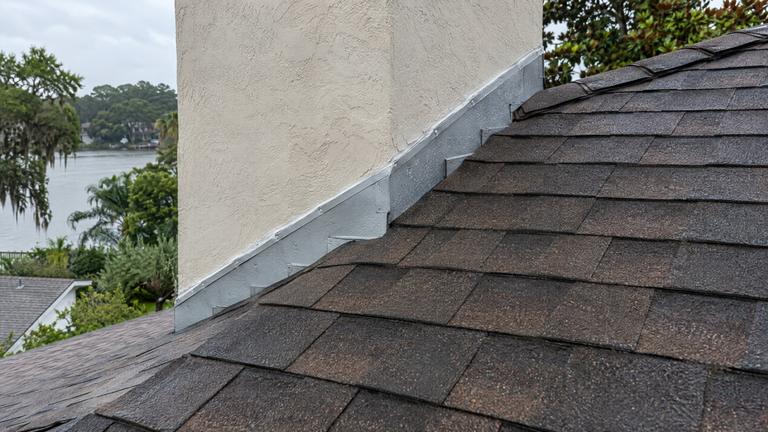
Chimney flashing replacement for Lorna Doone homeowners
Repair only what failed and know what you paid for. Written estimates and satisfaction guaranteed on flashing work in Lorna Doone.
- Licensed & insured
- Locally run
- Family owned and operated
- Same-day service available



What we check on Lorna Doone roofs before reflashing
Every line here is part of the free inspection in Lorna Doone, with no charge and no obligation.
- Step flashing along both sides
- Laps between counter and base flashing
- Mortar condition where counter flashing anchors
- 10% off within 72 hours after the inspection, shown in writing
Our approach to chimney flashing in Lorna Doone
Three parts of the job our flashing specialists explain to homeowners in Lorna Doone before any metal is ordered.
How step flashing works with each shingle course
Along the sides of a chimney on a shingle roof, flashing goes in as a run of short L-shaped pieces, one for each course. Every piece is tucked under the shingle above and over the shingle below, so metal and roofing overlap like scales all the way up the slope.
That weave is why step flashing cannot simply be slid in from the outside. Replacing it usually means lifting the shingles along the side of the chimney, pulling the old pieces and setting new ones course by course. Your written estimate says how many courses are opened and how the shingles go back.
Counter flashing on a stucco-faced chimney
Plenty of chimneys are finished in stucco over block rather than exposed brick, which means there are no visible mortar joints to set counter flashing into. The detail has to account for the stucco layer, how it sheds water and where the metal can actually be anchored.
We look at how the existing counter flashing was attached and whether water is getting behind the stucco above it. Then we propose a detail suited to that finish, which may mean cutting a groove for the metal or a surface-mounted piece with a proper seal. The method is explained in writing before any cutting.
Nails driven through exposed flashing
Fasteners belong where the next layer covers them. Nails driven through the face of exposed flashing, a common shortcut in patch repairs, leave holes that depend entirely on a dab of sealant and often rust out around the head.
We look for exposed heads along the apron, the counter flashing and any patch metal. Where they appear, the lasting fix is usually new metal fastened in the covered zone rather than more sealant over each nail. The count and location of exposed fasteners go into our written notes.
Folded or soldered corners
Corners can be closed by folding the metal into a tab that wraps around, or by soldering a seam on metals that accept solder, such as copper. Each method has its place, and each needs care to avoid a gap at the fold or the seam.
We explain which approach suits your flashing metal and chimney shape. Folded corners are common on aluminum and coated steel, while soldered corners are common on copper. Either way, each corner is sealed and checked before the roofing goes back over it.
Other work in Lorna Doone
-
-
-
-


- Stone Chimney RepairKeep stone repairs suited to the existing masonry.
- Smoke Chamber RepairRepair the transition above the fireplace opening.
Learn more about chimney flashing repairLorna Doone services
Chimney flashing questions from Lorna Doone
Short answers from our chimney team in Lorna Doone. Call for anything not covered here.
What metal do you use for chimney flashing?
It depends on the roof covering and the chimney face. We commonly work with aluminum, coated steel, stainless and copper, and the Florida code requires the metal to be corrosion resistant. The metal and its thickness are written into your estimate.
Why is chimney flashing made in two parts?
Base flashing is fastened to the roof and counter flashing to the chimney, and the lap between them lets each move a little without tearing a seam. BIA Technical Note 19B treats them as separate pieces for that reason. One-piece metal run from the roof into a mortar joint cannot flex, so we replace it with a two-part detail.
Request your free estimate
Share the job details and arrange a free inspection with our local team.
- Free inspection
- No hidden fees
- Family owned and operated
Need an answer now? Call (352) 675-6376
Your request is received
Thank you. We will contact you to discuss the job and confirm an appointment.