
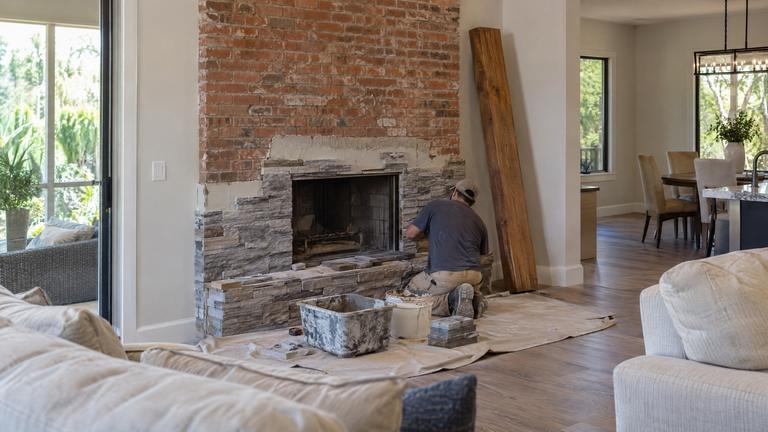
Chimney chase repair and rebuilding in Milk District
Your Milk District chase, repaired by a local family-owned company that puts every layer in writing first.
- Licensed & insured
- Locally run
- Family owned and operated
- Same-day service available



Chase work written up for Milk District homeowners
- Tap test for hollow or loose stucco
- Step or L flashing where the chase meets shingles
- Air space around the chimney pipe kept clear
- Temporary cover over any open section each day
Our approach to chase repair in Milk District
Rot along the top plate under the cover
The top plate is the horizontal framing at the very top of the chase walls. The metal cover rests on it, and it is the first wood to get wet when the cover leaks or rain blows past the edge. Rot often starts at the corners, where end grain soaks up water.
A soft top plate lets the cover sag, which holds more water and speeds up the rot. It can also pull fasteners loose from the siding just below it.
We check the top plate by hand whenever the cover is off. If it is soft, the plate and the upper ends of the studs are replaced before any cover goes back on. The cover shows up as its own line, so you can tell which job stops the leak and which one repairs the wood it already reached.
Open siding joints that let rain behind the finish
Siding on a chase takes wind-driven rain on all four sides, and the joints are the weak spots. Butt joints, where two boards meet end to end, open up as the boards dry and shrink. Nail holes near those ends can let water into the board itself. Joints in the lowest course and just under the top tend to take the most water.
Once water is behind the siding, the barrier underneath has to carry it down and out. If that barrier is torn or missing, the sheathing takes the water instead.
On a chase in Milk District, our crew looks at every joint on every face, including the side nobody sees from the street. Open joints on sound boards can be sealed or backed with flashing. Boards that are swollen or split at the ends are replaced, and the barrier behind them is checked before new siding goes up.
Straps and supports tied to the chase framing
Inside a tall chase, the chimney pipe may be held in line by straps or a stabilizer fastened to the chase framing. In DuraVent's DuraChimney II manual, for example, the stabilizer keeps the chimney centered in the chase and does not support its weight, and the same manual uses wall straps or stabilizers at set spacing to hold the air space around an enclosed chimney.
When the studs those parts are fastened to rot, the pipe can drift toward one wall. Replacing the framing without resetting the supports can leave the pipe off center and too close to the new wood.
Our crew marks each support before the framing comes out and refastens it to new framing in its listed position. We also check that the pipe stands plumb before the chase on your Milk District home is closed up.
Leaving the fireplace off while the chase is open
While a chase is open, the fireplace below it should not be used. Shields and firestops may be off, the air space is disturbed while framing is replaced and the chimney top may be uncovered. A tag on the fireplace is a simple reminder for everyone in the house.
The same goes for the time between finding serious damage and fixing it. A chase with charred framing, a shifted pipe or a missing shield should not see another fire until it is repaired. Heat from a fire rises straight into the top of the chase, which is the part most likely to be open or missing its shields during the job.
Our crew tells you when the fireplace in your Milk District home can be used again, which is after the chase is closed, the listed parts are back in place and the top is sealed. Until then, leave the tag on.
Other work in Milk District
-
-
-
-
-
-


Chimney chase repair questions in Milk District
Can you repair only the rotted part of my chase?
Often, yes. When rot is limited to the base, a corner or the top, our crew removes siding in that area, replaces the damaged wood and laps new barrier and flashing into the old. If probing shows rot running through most of the framing, we price a rebuild alongside the repair so you can compare.
How do you price damage you cannot see yet?
The estimate prices what the inspection can confirm and explains how hidden damage is handled. If opening the chase shows more rot, we stop, show you and write up the added work with its price. Nothing extra is done until you approve it.
Request your free estimate
Share the job details and arrange a free inspection with our local team.
- Free inspection
- No hidden fees
- Family owned and operated
Need an answer now? Call (352) 675-6376
Your request is received
Thank you. We will contact you to discuss the job and confirm an appointment.