
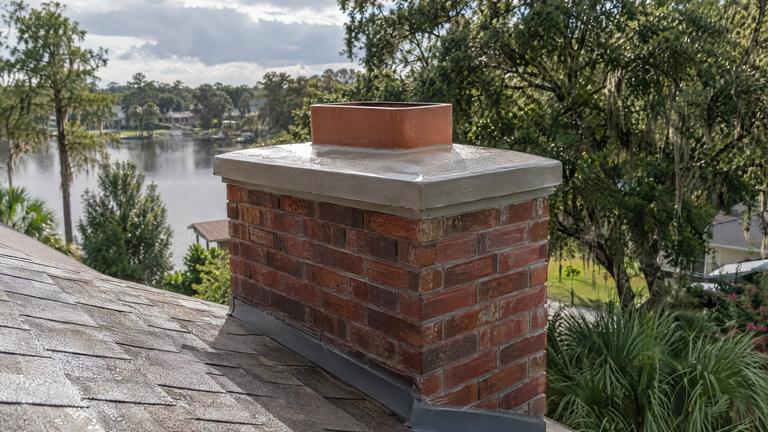
Your chimney crown repair team in Moss Park
A free inspection, straight answers about repair or rebuild, and crown work backed by our workmanship warranty.
- Licensed & insured
- Locally run
- Family owned and operated
- Same-day service available



Inside a written chimney crown estimate
- Tap test for hollow or loose crown sections
- Forms, reinforcement and a new cast crown
- Roof protection below the work area
- Roof access plan for the height and pitch
Chimney crown repair from the roof down
Thin mortar washes that pass for crowns
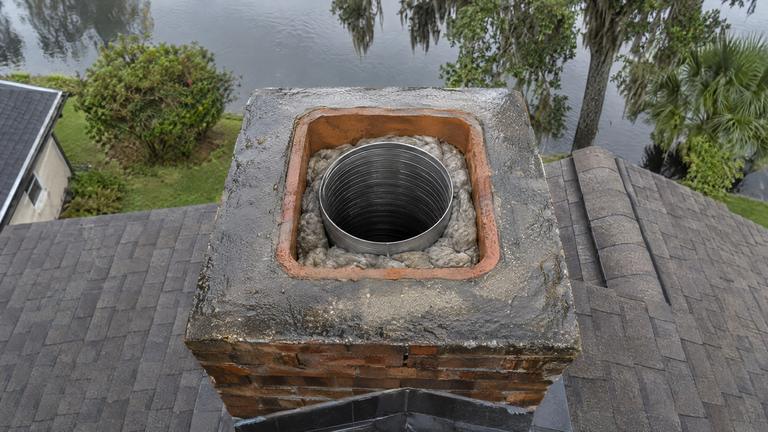
Many chimneys were topped with a mortar wash, a thin layer of mortar troweled over the top bricks and feathered to nothing at the edges. It looks like a crown from below, but it has no overhang, no drip and often very little slope. Heat and rain break it into plates that lift and let water underneath.
Brick Industry Association guidance cautions against tapering a cap to a thin edge. When our crew finds a mortar wash, we usually recommend removing it and casting a proper crown. The free inspection shows how far gone yours is before you decide anything.
Taking off a mortar wash is usually quick work, since the layer is thin and already loose. What sits underneath tells the rest of the story. If the top bricks are sound, a new crown can go straight on. If they are loose, they get relaid first, and the estimate shows that as its own line.
The drip groove most crowns are missing
Look closely at the underside of a crown's edge. A proper crown has a groove or drip line there that breaks the path of the water. Without one, rain clings to the underside, creeps back toward the wall and runs down the chimney face instead of dropping clear.
Dark streaks under the crown edge, or darker bricks at the very top of the chimney, often point to a missing drip. Our technicians check for it on every visit. On a new crown it comes standard, and on a sound crown we tell you honestly whether adding one is practical.
On some crowns a drip can be cut into the underside of a sound edge. On others the edge is too thin or too damaged to take one, and the drip only arrives with a new crown. Our crown pros check the edge thickness before promising either option.
Crowns on stone chimneys
Stone chimneys have irregular tops, and crowns on them often end up thin in some spots and thick in others. The low spots hold water and the thin spots crack first.
Our crown pros build the forms to the stone's shape so the new crown keeps a steady thickness and slope. If loose stones at the top need resetting first, that is listed separately. The free inspection gives you both answers at once.
Stone tops often have deep joints that hold water. Where the crown meets irregular stone, our crew fills and shapes the bedding so the crown sits solidly with no hollow pockets underneath, which keeps it from rocking or cracking over uneven support.
Crown work above a metal roof
Metal roofs are slick, especially when damp, and the panels dent under point loads. Crown work over a metal roof takes careful footing and padding under anything that gets set down.
We schedule metal-roof jobs for dry conditions and protect the panels below the chimney. Concrete dust and chips are rinsed or swept off before we leave, since grit left on metal can scratch the finish long after the crew is gone.
Metal roofs also make crown debris easy to spot. Chips and dust show clearly on the panels, so our cleanup is thorough and simple for you to check. Before we leave, walk the yard with our technician and look up at the roof around the chimney together.
Other work in Moss Park
-
-
-
-
-
-


Chimney crown repair questions in Moss Park
Can a cracked crown be sealed instead of replaced?
Often, yes, when the cracks are fine and the concrete around them is still sound. A coating made for chimney crowns bridges small cracks once they are cleaned and filled. If the crown is hollow, broken at the edges or has no slope, sealing only delays the next leak, so we recommend a new crown instead.
How soon can I use the fireplace after a new crown?
It depends on the material. A coating needs dry hours to set, and a newly cast crown needs time to cure before a hot fire runs beneath it. We give you the waiting time for your product in writing at handover.
Request your free estimate
Share the job details and arrange a free inspection with our local team.
- Free inspection
- No hidden fees
- Family owned and operated
Need an answer now? Call (352) 675-6376
Your request is received
Thank you. We will contact you to discuss the job and confirm an appointment.