
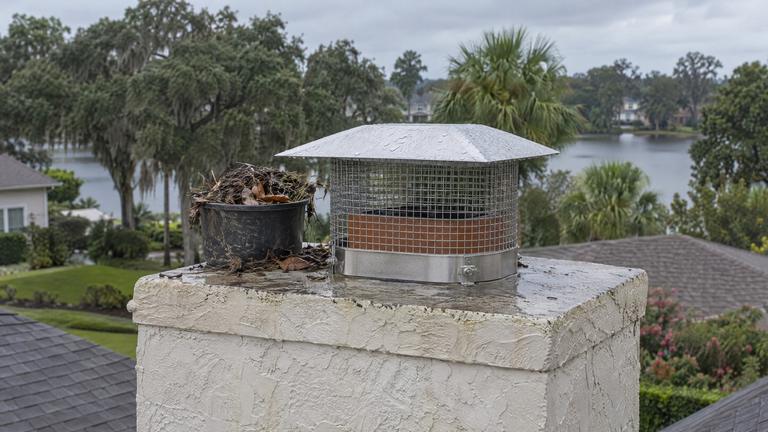
Careful chimney animal removal for Tangerine homes
Keep the fireplace off and call our local pros. We assess your Tangerine chimney and give you a written plan at no charge.
- Licensed & insured
- Locally run
- Family owned and operated
- Same-day service available



How we price animal work in Tangerine chimneys
- Rules that apply to that animal, explained
- Damper and fireplace doors secured
- Chimney sweep after nesting
- Written record of the work
Getting animals out of Tangerine chimneys the right way
If a bat may have touched someone
The CDC advises contacting a doctor or the local health department after any possible contact with a bat, including waking to find a bat in the room. Do not try to catch or handle it with bare hands. Once that question is settled, we look for the route the bat used, which is often an uncapped flue or a gap at the cap, and plan an exclusion that follows Florida's timing rules. Keep the bat contained in one room if you can, without touching it, in case it needs to be tested.
Screen sizes the residential code sets
The Florida residential code, in section R1003.9.2, sets the size of spark arrestor screen openings on masonry chimneys. The openings must not pass a sphere larger than half an inch and must not block a sphere smaller than three-eighths of an inch. That range keeps out birds, bats and squirrels while letting smoke through. Caps we install on masonry flues follow it. A screen with larger openings may look sturdier and still let bats and small birds slip through.
Exclusion before the opening is sealed
For bats, and as a principle for every animal, the opening is sealed only after the animals inside have had a way out. With bats, exclusion devices do that job outside the maternity season. With other animals, it may mean waiting for departure or having a specialist remove them. Sealing first is how animals end up trapped and dying in a chimney, which is why we never do it. The same principle applies to a chase or an attic opening near the chimney, which is sealed only once it is empty.
Birds other than chimney swifts
Chimney swifts are not the only birds the Migratory Bird Treaty Act covers. The Act protects listed migratory birds, their nests and their eggs. When a nest in the flue or the cap belongs to a bird we cannot identify with confidence, we treat it as protected and plan the removal and the cap for when the nest is no longer active. That can mean a short wait, and the fireplace stays off while we wait.
Other work in Tangerine
-
-
-
-
-


Before you call about an animal in Tangerine
What are the rules for bats in a chimney?
Florida restricts bat exclusion during the maternity season, April 16 through August 14, and exclusion devices are used before openings are sealed. We explain the timing that applies when you call.
Why do you check the smoke shelf?
Nest material and droppings often land on the smoke shelf behind the damper, out of sight from the room. We clear it during the cleanup, so debris does not stay in the smoke path.
Request your free estimate
Share the job details and arrange a free inspection with our local team.
- Free inspection
- No hidden fees
- Family owned and operated
Need an answer now? Call (352) 675-6376
Your request is received
Thank you. We will contact you to discuss the job and confirm an appointment.