
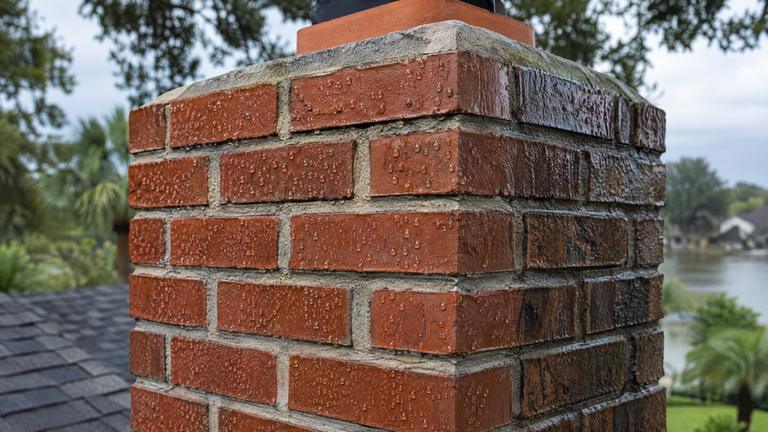
Chimney waterproofing done in the right order in The Willows
Sound masonry first, a breathable repellent second. Book a free chimney inspection in The Willows with our family team today.
- Licensed & insured
- Locally run
- Family owned and operated
- Same-day service available



Your free waterproofing inspection in The Willows looks at
Recorded by our local family team in The Willows, then explained in plain language before you decide.
- Condition of the brick faces above the roofline
- Stucco or stone surfaces and the product that suits them
- White salt deposits and the moisture behind them
- Workmanship warranty on the application we perform
Our approach to chimney waterproofing in The Willows
Practical points from our waterproofing crew in The Willows.
Hairline cracks and structural cracks
Very fine surface cracks and deep cracks through brick or mortar are different problems. A penetrating repellent rarely holds back water at a crack wider than about 0.02 inch, and a crack that is still moving can open again whatever goes over it.
We look at the pattern, width and location of each crack. A stepped crack through joints or a crack that runs through several courses gets a repair plan, and sometimes a closer look at why it formed. Fine cracking on a sound face may be something a treatment can help with. Either way, you get the reasoning in writing.
Matching a new coat to the old one
On a chimney treated in the past, any new product has to work with what is already in the masonry. Penetrants are typically incompatible with existing film-forming coatings, and mixing chemistries can cause clouding.
This is why we keep product records and ask for yours. If the earlier treatment was a siloxane penetrant, a compatible fresh coat may be straightforward. If no one knows what was used, we test a small area before committing to the whole chimney, and we tell you plainly if the result is not good enough.
Keeping a record of what went on the chimney
Once the job is done, we leave you the product name, the maker's data sheet, the faces treated and the date. It sounds like paperwork, but it answers the questions the next contractor, home inspector or buyer will ask.
It also protects the chimney. Future cleaning methods, patches and coatings all need to be checked against what is already in the masonry. With the record in hand, nobody has to guess. We keep a copy on file too, so a call to our local team gets you the details if yours go missing.
The area behind a wide chimney
A wide chimney on a sloped roof often has a small peaked structure behind it, called a cricket or saddle, that sends water around the chimney instead of letting it pool. Water that pools behind the chimney soaks into the masonry and finds every weakness.
During the inspection we look at that area closely. Standing water marks, debris build-up and worn flashing there are roof and flashing items. A repellent on the brick above helps with absorption, but it will not solve water that sits against the chimney after every storm.
Other work in The Willows
-
-
-
-
-
-


Asked in The Willows about chimney water repellent
Short answers from our chimney team in The Willows. Call for anything not covered here.
Do cracks and loose mortar need fixing first?
Yes. Masonry guidance says a repellent rarely seals a crack wider than about 0.02 inch, and open joints let water straight in. We repair those first, let the mortar cure and then treat the sound masonry.
Will you test the product on my chimney first?
Yes. Brick and mortar vary, so product makers and masonry guidance recommend a test area, and the Brick Industry Association suggests at least ten square feet. We pick a face you can see, let the test cure and look at the finish and the way water behaves on it before treating anything else.
Request your free estimate
Share the job details and arrange a free inspection with our local team.
- Free inspection
- No hidden fees
- Family owned and operated
Need an answer now? Call (352) 675-6376
Your request is received
Thank you. We will contact you to discuss the job and confirm an appointment.