
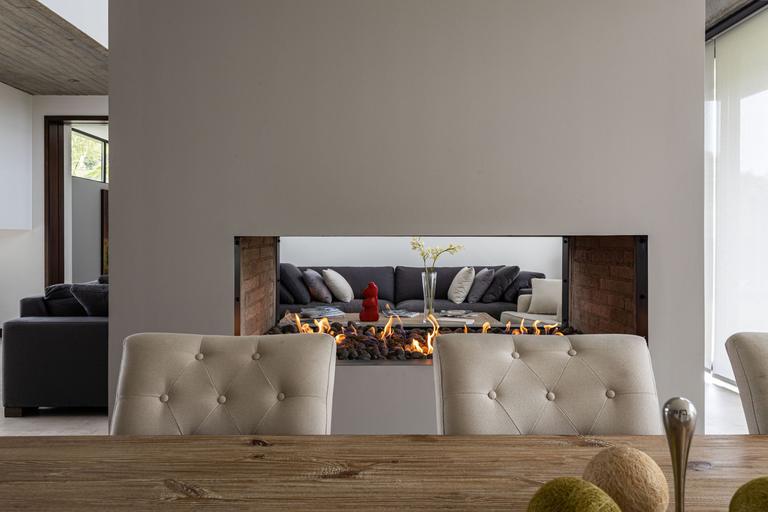
Propane and natural gas fireplace repair in Zellwood
Repairs with the parts your maker specifies, so the fireplace stays within its listing.
- Licensed & insured
- Locally run
- Family owned and operated
- Same-day service available



Your Zellwood gas fireplace scope in writing
- Inlet and manifold pressure read with a manometer
- Burner ports, burner alignment and orifice condition
- Ember material renewed and kept off the ports
- Pilot pattern and main burner lighting checked afterward
Gas fireplace details worth knowing
How a millivolt standing pilot system works
A millivolt system makes its own power from the pilot. On the millivolt pilots in two vent manuals, the pilot splits into three distinct flames. One heats the thermocouple, one heats the thermopile and one reaches toward the main burner.
Each of those two parts turns the heat into a small voltage. The thermocouple's output holds the pilot safety in the gas valve, and when it fades the pilot safety drops out. The thermopile's output powers the switch or remote circuit that opens the main burner, which is why one Heatilator manual says house power on its standing pilot units serves optional accessories and warns that wiring line voltage to the millivolt valve damages it.
A fault can sit in any link of that chain, from a weak thermocouple or tired thermopile to a loose lead, a switch or the valve itself. For Zellwood homeowners, each link is tested in order before a part goes on the estimate.
Leak checks on the appliance connections
A yearly service list we follow includes a leak check of every accessible gas-carrying tube, connection and fitting. The fuel gas code allows leaks to be located with an approved gas detector, a noncorrosive leak detection fluid or another approved method, and the fireplace manuals add that an open flame is never used.
One natural vent manual also warns against spraying solution onto the control body, and notes that excess pipe compound can set off an electronic detector. A leak on the appliance's own valve, pilot or burner joints is part of the fireplace repair, while one on the connector or the supply piping is referred to the plumber or gas installer who works on house piping.
Any fitting disturbed during a repair is checked before the fireplace is lit again, as the installation manuals direct. On repair and service visits in Zellwood, our technician uses that manual's list of points as a guide.
- The pipe from the supply connection to the gas valve
- Every joint on the valve and control body
- The burner and pilot connections
- Field-made and factory-made joints alike
Grounding and the fireplace circuit
Any fireplace with a fan, lights or electronic ignition is also an electrical appliance. The manuals we have read require it to be wired and grounded per local codes or, where there are none, the National Electrical Code. Florida's fuel gas code adds a rule that is easy to miss. Gas piping shall not be used as a grounding electrode.
Ground matters to the ignition as well as to shock safety. An electronic ignition troubleshooting table lists poor or no system ground as a cause of a pilot that sparks but never lights, and has the ground wire on the valve wiring checked at the metal chassis. A natural vent chart from another maker notes that a poor or erratic ground may cause an occasional shutdown even when the fireplace works normally at checkout.
Inside the appliance, our technician tests the ground connections and labels wires before disconnecting any control, as the manuals direct. A fault in the house wiring is noted on the estimate for a qualified electrician.
Ticking and pinging as the fireplace heats
Steel moves as it heats and cools. A question table in one owner's manual describes a metallic noise caused by metal expanding and contracting, like a furnace or heating duct, and says it does not affect the operation or longevity of the appliance. Two vent manuals from another maker call the same start-up and cool-down sounds normal for fireplaces made of steel.
Timing separates normal from not. Expansion noise shows up as the unit warms and again as it cools, then settles. A steady grind, rattle or hum that lasts as long as the fan runs comes from a moving part, and a sound that began after a repair or after the logs were moved deserves a mention.
On service visits in Zellwood, our technician listens through a lighting cycle before deciding that a noise needs a part. If it is only expansion, you hear that plainly and nothing is added to the estimate.
Other work in Zellwood
-
-
-
-
-
-


Learn more about gas fireplace repair and serviceZellwood services

Before you book fireplace service in Zellwood
Which gas fireplace brands do you work on?
We work from the model on the rating plate and the maker's own manual rather than a list of brands. If we cannot confirm the manual or the parts for your unit, we tell you before any work and note it on the estimate. Vent-free units go to our ventless gas fireplace service.
Should I repair my old gas fireplace or replace it?
That depends on the unit's condition, how often it has failed and whether the maker still supplies its parts. A look-alike part cannot go into a listed appliance, so when parts are gone, replacement may be the honest answer. We lay out both options in writing and route replacement to our gas fireplace installation service.
Request your free estimate
Share the job details and arrange a free inspection with our local team.
- Free inspection
- No hidden fees
- Family owned and operated
Need an answer now? Call (352) 675-6376
Your request is received
Thank you. We will contact you to discuss the job and confirm an appointment.