
Stone chimney repair specialists for Plymouth homes
Upfront prices and no hidden fees on stone chimney repair in Plymouth, with the whole plan on paper first.
- Licensed & insured
- Locally run
- Family owned and operated
- Same-day service available



Repointing and reset items for Plymouth homes
Go through it with our family-owned crew in Plymouth, and ask about any line before you sign.
- Natural stone or manufactured veneer identified
- Drainage at the base and terminations checked
- Earlier hard cement or caulk patches noted
- Deep joints filled in layers
Stone chimney repair, explained for Plymouth homeowners
How the masons who repoint stone in Plymouth explain the work to neighbors.
What the code says about adhered stone veneer
Section R703.12 of the residential code covers adhered masonry veneer, the category manufactured stone falls into. It accepts the manufacturer's instructions as one installation route, and on framed walls it pairs the veneer with a water-resistive barrier plus a screed or flashing that resists corrosion at the foundation line.
In practice, that makes the maker's installation guide the working document for repairs too. We follow the guide for the stone on your chimney when one is known, and the general standard practice when the product cannot be identified.
The weep screed at the bottom of the stone
On framed walls, a corrosion-resistant weep screed at the base of the veneer gives water behind the stone a way out. The same maker notes that most building codes require one in framed applications and that the barrier laps over its flange.
A screed that is buried, painted over, mortared shut or missing traps water inside the wall. We check the base of every veneer chimney and describe what we find, since loose stones near the bottom of a chase often trace back to this detail.
Handling mortar smears on the stone
Accidental smears and droppings on the face of manufactured stone should be removed only after the mortar has become crumbly, using a whisk broom or dry bristle brush, according to the maker. A wet brush or wire brush is never used, since it can cause staining that may be impossible to remove.
We protect finished stone below the work area and brush smears at the right moment. It is slower than wiping them away wet, and it keeps the face of your stone clean.
How deep to rake out stone joints
The National Park Service's Preservation Brief 2 sets the raking depth at 2 to 2 and a half times the joint width as a minimum, so new mortar bonds and stays put. For stone masonry with wide joints, that can mean several inches.
Loose or crumbling mortar beyond that depth also comes out. The brief shows new mortar falling out of a joint that was not prepared deeply enough. We rake to a sound depth and show you the prepared joints before filling.
- At least 2 to 2 and a half times the joint width
- Deeper where mortar is loose
- Square back so new mortar locks in
Tooling timing and joint color
When the last layer is thumbprint hard, the joint is tooled to match the existing profile. According to the brief, early tooling dries paler and risks fine cracks, and late tooling marks the joint with dark tool burning and fails to seal tight to the stone.
Our masons check joints by hand as they go, so each area is tooled at the right moment. Consistent timing is how the joint color stays even across a repair.
Other work in Plymouth
-
-
-
-
-


Quick stonework facts for Plymouth chimneys
Our family-owned team in Plymouth hears these stone questions on almost every visit.
Can I pressure wash my stone chimney?
We advise against it. One manufactured stone maker rules out power washing, sandblasting, wire brushes and acid cleaners, and high pressure can erode mortar joints on natural stone too. A mild detergent and a bristle brush are the safer start.
Do you repair the chimney cap on a stone chimney?
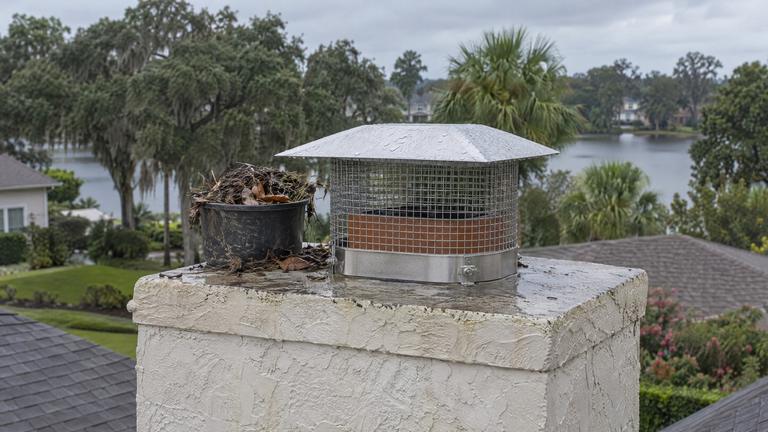
Yes, as a separate line. The cap or crown sheds water off the top of the chimney, and a failed cap can be why stones are loosening below. We note its condition during the stone inspection and price any cap or crown work on its own.
Request your free estimate
Share the job details and arrange a free inspection with our local team.
- Free inspection
- No hidden fees
- Family owned and operated
Need an answer now? Call (352) 675-6376
Your request is received
Thank you. We will contact you to discuss the job and confirm an appointment.